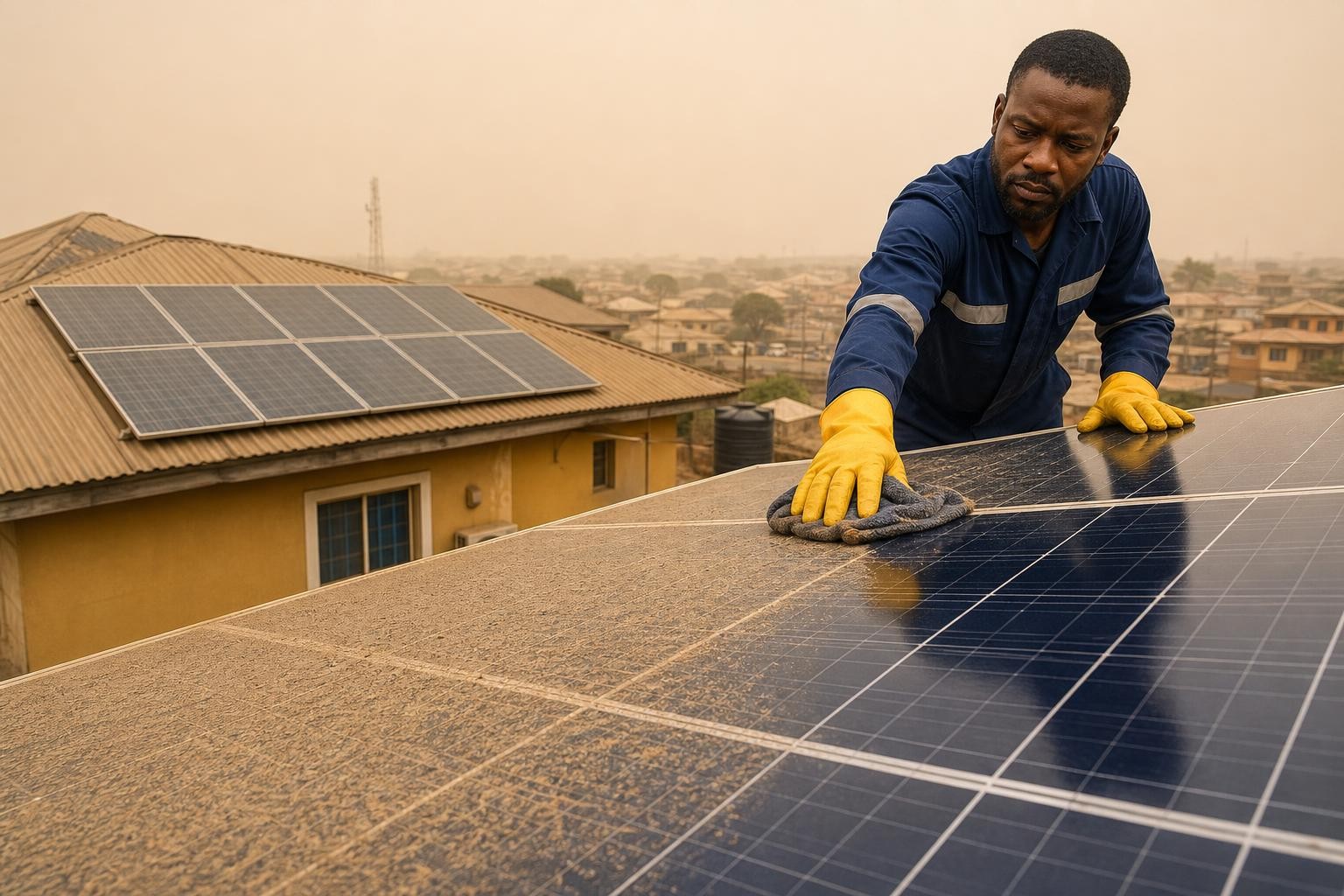
Last reviewed: September 23, 2026
Harmattan dust can reduce the energy your solar panels deliver, but there is no single loss percentage that applies to every Nigerian home. The practical answer is to measure your own system: compare daily solar energy on similar clear days before and after safe cleaning, then calculate the difference.
As a planning guide, a dirty array may lose anything from a small amount to a serious share of its output, depending on the thickness of the dust, location, panel angle, weather and how long the dirt remains. A study in Kazaure, northern Nigeria, reported up to 30% lower panel output under environmental dust during its test period. A newer West Africa study modelled Harmattan-related losses above 50% in the most affected locations. Those figures are evidence that the problem can be large, not a promise that your rooftop will lose the same amount.
Use this rule: if your panels are visibly dusty and your measured daily PV energy has fallen while the weather and load are otherwise similar, clean or arrange a safe professional inspection before buying more panels or a bigger battery.
What Harmattan dust is doing to your solar system
Harmattan affects solar systems in two related ways:
- Surface soiling: dust settles on the panel glass and blocks, scatters or absorbs some of the sunlight that should reach the cells.
- Atmospheric dust and haze: dust remains in the air and reduces the sunlight reaching the panels even when the glass is clean.
Cleaning can help with surface soiling. It cannot remove dust haze from the atmosphere, clouds, shade from a tree or a fault in the inverter. This distinction matters because a clean panel can still produce less power on a hazy Harmattan day than on a clear day.
The effect is often worse when dust stays on the array for many days, when the panels are nearly flat, or when light rain turns dust into a muddy film. Panels near unpaved roads, construction sites, farms, busy traffic corridors or dry open ground may soil faster than panels in a cleaner environment.
How much energy can dust cost you?
Start with the energy your system normally produces, not the wattage printed on the panel. A 550W panel is rated under test conditions; it does not produce 550W every hour from morning to evening.
A useful estimate is:
Daily energy lost = clean-day PV energy × estimated dust-loss percentage
For example, suppose your inverter records about 8 kWh of solar energy on a comparable clean, clear day. If dust is reducing output by 15%:
8 kWh × 15% = 1.2 kWh lost per day
Over 30 days, that is approximately:
1.2 kWh × 30 = 36 kWh of solar energy not produced
That lost energy may show up as:
- less energy available to charge the battery;
- a battery that reaches evening at a lower state of charge;
- shorter night-time backup;
- more grid or generator use; or
- slower recovery after a cloudy or rainy day.
For a system with a 5 kWh lithium battery, losing 1.2 kWh of PV energy does not necessarily mean the battery loses exactly 1.2 kWh of usable AC backup. Charging, inverter and battery losses still apply. It does mean that roughly 1.2 kWh less energy was available to be allocated between daytime loads and charging on that day.
How to convert lost solar energy into a naira estimate
Solar energy is not normally sold from a home system, so the “cost” of dust is usually the cost of replacing the missing energy with grid supply, petrol or diesel generation, or extra battery capacity.
Use this formula with your own replacement cost:
Monthly replacement cost = monthly energy lost × your actual replacement cost per kWh
Using the 36 kWh example, if your own blended cost of replacing one kWh with grid, generator fuel and maintenance is ₦350, the illustration would be:
36 kWh × ₦350 = ₦12,600
This is only a worked example. It is not a current national Nigerian electricity or fuel price. Your cost may be different because generator efficiency, fuel price, appliance load, tariff, battery charging and maintenance all vary. If you do not know your replacement cost, track the extra fuel or grid energy used before and after cleaning instead of using a national assumption.
There is also a non-financial cost. If dust causes a 1.2 kWh daily shortfall, a system designed to run selected lights, fans, internet equipment and a television may reach its low-battery limit earlier. That can be more important to a Nigerian household than the theoretical naira value of the lost solar energy.
What Nigerian evidence tells us—and what it does not
Research confirms that dust and Harmattan can materially affect PV performance in Nigeria and West Africa, but the result is highly location-specific.
| Evidence | What it supports | What you should not assume |
|---|---|---|
| Kazaure, northern Nigeria study | Environmental dust can reduce panel output; the study reported losses of up to 30% during its test period. | Every Nigerian rooftop loses 30% during every Harmattan. |
| West Africa Harmattan modelling | Severe aerosol and soiling conditions can create very large seasonal losses in the most affected areas. | A regional worst-case result is the average loss for Lagos, Abuja, Enugu or your street. |
| Your inverter history | Shows what your own array is actually producing under your own weather, load and equipment limits. | One low reading proves that dust is the only fault. |
The right takeaway is not “Harmattan always costs 30%.” It is “dust deserves to be measured because the possible loss is large enough to affect backup reliability and upgrade decisions.”
How to Estimate Your Own Harmattan Loss
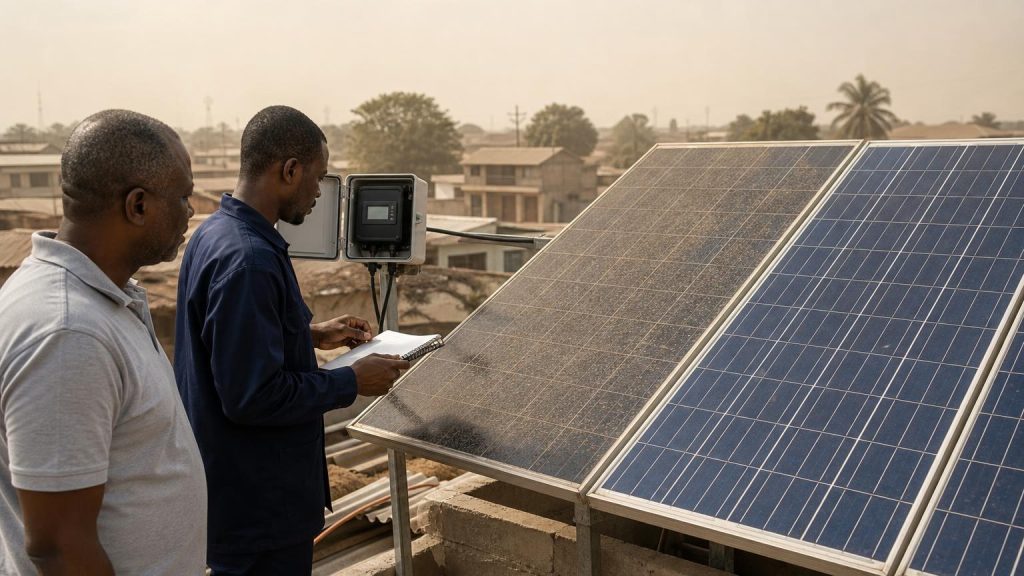
The simplest home test is a before-and-after comparison. It is more useful than guessing from the panel label.
Method 1: Compare daily PV energy
- Record the inverter’s daily PV energy for at least two or three days while the panels are dusty.
- Note the weather, panel shade, battery state of charge and important daytime loads.
- Have the panels cleaned safely, or arrange for a qualified technician to do it.
- Record the same readings for another two or three days with similar weather and similar loads.
- Calculate the estimated soiling loss.
Estimated dust loss (%) = (clean-day energy − dirty-day energy) ÷ clean-day energy × 100
Example:
- Comparable clean-day production: 8.0 kWh
- Comparable dusty-day production: 6.8 kWh
- Difference: 1.2 kWh
- Estimated loss: 1.2 ÷ 8.0 × 100 = 15%
Try not to compare a bright, cloudless day with a rainy or heavily hazy day. If the weather changes too much, the result will include cloud and atmospheric effects, not only dirt on the glass.
Method 2: Compare output at similar times
If your inverter does not record daily kWh, take readings around the same time on several clear days. Check the actual PV watts, not only battery charging watts. Your appliances may be using solar power directly, and a nearly full battery may cause charging power to fall even when the panels are working normally.
This method is less accurate than daily energy tracking because clouds can pass quickly and panel temperature changes during the day. Use it as a warning check, not as a laboratory measurement.
Method 3: Check the panels and the system together
Before blaming dust, check for:
- new shade from trees, buildings, water tanks or satellite dishes;
- cloud, rain or heavy Harmattan haze;
- a battery that is already close to full;
- daytime appliances consuming most of the PV energy;
- inverter or charge-controller limits;
- loose, damaged or overheated cables and connectors; and
- fault alarms or a panel/string problem.
If your panels are clean but output remains low, use SolarPriceNG’s guide to diagnosing low solar-panel power before assuming that you need more panels.
When should you clean solar panels during Harmattan?
There is no universal Nigerian cleaning calendar. The right interval depends on how quickly dust settles, the panel angle, rainfall, nearby roads or construction, bird activity and how safely the array can be reached.
A practical Harmattan routine is:
- inspect the panels from the ground or another safe position regularly;
- clean when a visible dust film is building up or your measured production is falling without another clear reason;
- check again after dusty winds, construction activity or light rain that leaves muddy residue; and
- keep a simple record of cleaning dates and daily PV energy.
Do not clean only because the calendar says so if the job is dangerous or the panels are already clean. Conversely, do not wait for the inverter to shut down if a thick dust layer is clearly reducing the energy you need.
For a broader inspection and care routine, see How to Maintain Solar Panels in Nigeria.
How to Clean Dust Safely Without Damaging the System
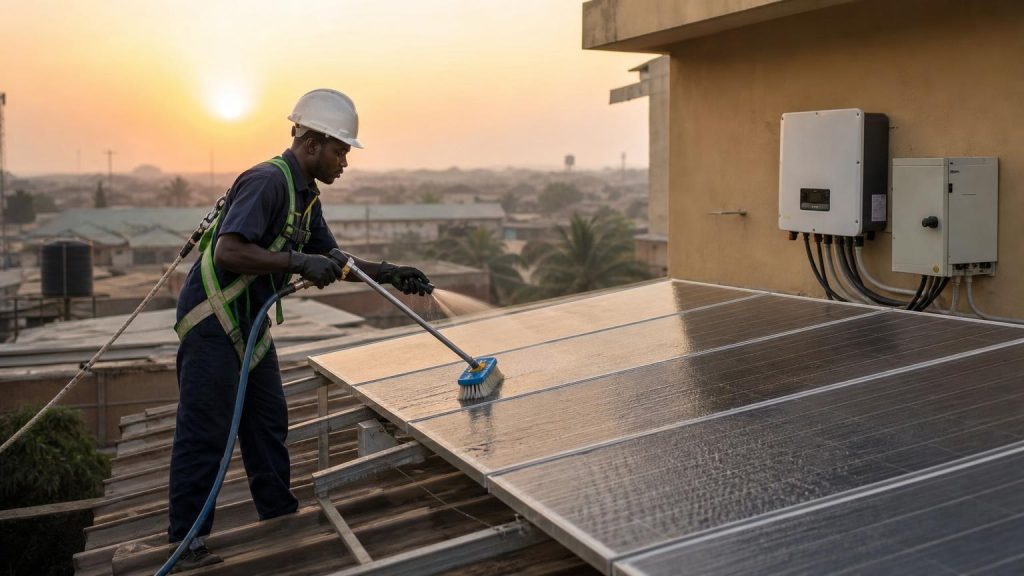
Cleaning can restore some output, but unsafe cleaning can cause roof falls, electric shock, cracked glass or scratched panels.
- Choose a cool time, such as early morning, and avoid wet, slippery or windy roof conditions.
- Use clean water and a soft, non-abrasive brush or cloth for normal dust.
- Loosen dry dust gently; do not grind it into the glass by aggressive dry rubbing.
- Do not use sand, metal tools, abrasive powder, petrol, diesel, bleach or harsh solvents.
- Do not spray high-pressure water at connectors, junction boxes, cable entries, the inverter or the battery.
- Never step on the panels.
- Do not wash a cracked panel or touch exposed wiring.
Solar panels can still produce dangerous DC voltage in daylight, even when the inverter is switched off. If the array is on a high, steep or fragile roof, let a properly equipped solar technician handle the work. The same technician can inspect cables, connectors, mounting and protection devices while cleaning.
When cleaning will not solve the problem
Cleaning is not the answer when the main cause is:
- atmospheric haze or cloud cover;
- new or seasonal shade;
- a failed panel or bypass-diode problem;
- loose, corroded or overheated wiring;
- incorrect panel-string configuration;
- a controller or inverter PV limit;
- a battery that is already full and therefore accepting less charge; or
- an ageing battery that cannot hold its expected usable energy.
If production is still unusually low after safe cleaning and several comparable clear days, do not keep buying equipment at random. Ask a qualified technician to compare PV voltage, current, string readings, controller/inverter readings and battery behaviour.
Should you add more panels to compensate for Harmattan?
Do not automatically oversize the array just because Harmattan exists. First measure the seasonal loss and decide what level of reliability you need.
More panels may be reasonable when:
- your battery regularly fails to recover after normal cleaning and fault checks;
- you need faster recovery after cloudy or dusty days;
- the inverter and charge controller have room for additional PV; and
- the added array can be installed with correct voltage, current, cable, protection and mounting design.
However, more panels will not cure a dirty array that nobody maintains, a bad connection or a battery that is too small for the night load. If you are estimating recovery after poor weather, read how much extra solar may be needed after a cloudy day. For a first sizing estimate, use the SolarPriceNG Solar Panel Calculator, then confirm the final design against the actual equipment manuals.
A simple Harmattan decision checklist
- Are the panels visibly dusty, muddy or covered with bird droppings?
- Has daily PV energy fallen compared with similar clear days?
- Could haze, cloud or new shade explain part of the reduction?
- Is the battery already full, or are daytime appliances consuming the solar energy?
- Are there inverter alarms, loose-looking cables or signs of overheating?
- Can the array be cleaned without unsafe roof access?
- Did production improve after cleaning?
- If not, has a qualified technician tested the panels, strings, controller and inverter?
- Only after those checks: would more panels solve a measured seasonal energy shortfall?
Bottom line
Harmattan dust can cost you real solar energy, but your loss is not determined by a generic national percentage. Measure the PV energy your system produces on comparable dusty and clean days, calculate the difference, and connect that shortfall to the extra grid or generator use you actually experience.
A Nigerian study has reported up to 30% lower output under environmental dust in northern Nigeria, while West Africa modelling shows that severe Harmattan conditions can cause much larger losses in the most affected locations. Treat those results as a warning about the possible scale—not as a promise about your home.
The most cost-effective first step is usually simple: inspect the panels, clean them safely when necessary, compare daily PV readings and investigate other faults before buying new equipment. If the measured seasonal shortfall remains important after maintenance, then use the data to decide whether more panels, a larger battery, lower loads or another charging source is the better investment.
Technical references
- Effect of Environmental Dust on the Performance of Photovoltaic Panels in Northern Nigeria — field study in Kazaure, northern Nigeria.
- Dust aerosol effects on decentralized solar: A cause of systematic undersizing of solar panels in West Africa — regional modelling of aerosol and soiling effects.
- NIMET State of the Climate in Nigeria — background on dry-season Harmattan winds and dust haze.