Last reviewed: September 28, 2026
Yes—if many of your important loads can run while the sun is available, designing around daytime solar use can be cheaper and simpler than buying a very large battery. The practical approach is to use solar directly for daytime appliances, reserve the battery for night-time and essential backup, and keep loads that must run continuously on the right backup circuit.
This does not mean “do not buy a battery.” In Nigeria, evening outages, poor grid supply and sudden changeover needs still make battery storage useful. It means you should not size the battery to cover energy that you can use directly during the day.
When daytime solar use is the better design
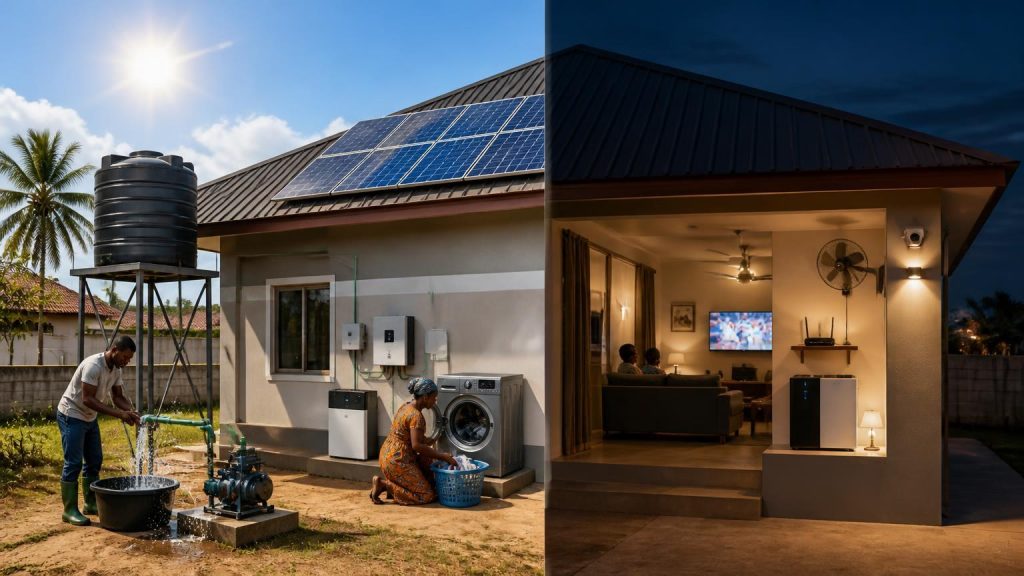
Daytime-first design makes sense when you can move flexible, high-energy appliances into daylight hours. Examples include a borehole pump that fills a storage tank, a washing machine, pressing iron, kettle, microwave, water pump, office equipment or some workshop tools.
- Use solar directly for loads that can wait until late morning or afternoon.
- Use the battery for night-time lighting, fans, television, internet equipment, security devices and other essential loads.
- Keep a generator or grid source available for long cloudy periods, unusually heavy loads or appliances that cannot be interrupted.
For a Nigerian home or small business, this can reduce battery cycling, lower the required battery capacity and make a modest solar system more useful. The best result comes from a usage plan, not from simply adding panels and hoping the battery will last longer.
Which appliances should move to daytime?
| Appliance or load | Daytime-first suitability | Practical Nigerian approach |
|---|---|---|
| Borehole or water pump | Usually good | Pump into a storage tank when solar is available instead of trying to run the pump from batteries at night. |
| Pressing iron, kettle or microwave | Good, but high power | Use one at a time during strong sunlight and confirm the inverter can handle its running and starting demand. |
| Washing machine | Usually good | Run the cycle during daylight when solar can supply much of the energy directly. |
| Freezer or refrigerator | Not a full load-shifting target | Keep it powered as needed. You can reduce other loads during the day, but do not switch a food appliance off casually for long periods. |
| Router, CCTV and security lights | Usually essential | Keep these on the protected backup circuit if you need them during a blackout, including at night. |
| Air conditioner | Depends on the system | Daytime use may help, but compressor starting demand and sustained power consumption can require a large inverter and battery-free daytime capacity. |
| Lighting, fans and television | Often night-time loads | These are normally better candidates for a smaller battery-backed essential-load circuit. |
The table is a planning guide, not permission to connect every appliance to one inverter. Check the appliance rating, simultaneous load, starting surge and the inverter’s continuous output before changing your wiring or usage pattern.
Why daytime use can reduce the battery you need
A battery is needed when the solar energy is not available at the time the appliance is being used. If a load runs directly from solar during the day, that energy does not need to pass through the battery first.
Here is a simple example. Assume a Nigerian home wants to run a 1,200W pump for 3 hours during daylight:
- Energy used by the pump = 1,200W × 3 hours = 3,600Wh, or 3.6kWh.
- If the pump runs directly from a suitable solar-and-inverter setup during the day, much of that energy can come from the panels at the time of use.
- If the same pump energy had to come from a battery, an example 90% inverter efficiency would require about 4.0kWh from the battery side: 3.6kWh ÷ 0.90.
- If a planning assumption allowed only 80% of the battery’s nominal energy to be used, the example would point towards about 5kWh nominal storage: 4.0kWh ÷ 0.80.
The 80% figure above is only an example assumption. The correct usable fraction depends on the battery chemistry, manufacturer’s limits, temperature, age, discharge rate and inverter settings. Lithium batteries should primarily be planned in usable kWh where that specification is verified. Tubular, GEL and AGM batteries are normally described in Ah together with voltage, not by comparing Ah alone with lithium.
This is why a storage tank can be more useful than a very large battery for a borehole. You store water during sunny hours instead of storing all the pumping energy in batteries for night-time use.
The solar panels still need to be large enough
Moving an appliance to daytime does not make its energy demand disappear. The panels, inverter and wiring must still supply the load safely while it is running. A 1,200W pump needs more than a 1,200W panel label in many real installations because solar output changes with heat, dust, cloud, shading, orientation and system losses.
You also need enough spare power to charge the battery for evening use. For example, if daytime appliances consume nearly all the solar power, the battery may finish the afternoon no fuller than it was in the morning. That can leave you with excellent daytime performance but poor night-time backup.
- Estimate the daytime load energy.
- Estimate the battery energy needed for evening and night-time essentials.
- Allow solar capacity for both the live daytime load and battery charging.
- Check the inverter’s maximum PV input, MPPT voltage range and current limit.
- Leave room for lower production during cloud, rain, Harmattan dust and hot conditions.
Do not assume that panels produce their nameplate wattage continuously. A system that works well at midday may produce much less in early morning, late afternoon or during heavy cloud.
A practical daytime-first plan for a Nigerian home
Start by separating your appliances into three groups:
- Must run at any time: router, CCTV, security equipment, selected lights, medical equipment where applicable and a refrigerator or freezer that needs continuous operation.
- Can run mainly during the day: water pumping, washing, ironing, cooking with high-power appliances and other flexible work.
- Can be reduced or postponed: optional entertainment, extra fans, decorative lighting and appliances that do not need to run during an outage.
Then decide which appliances should be on the inverter-backed circuit and which should remain on the normal supply or a separate controlled circuit. This is often more useful than trying to back up every socket in the house.
If your aim is only to keep essential appliances running during an outage, see the SolarPriceNG guide to planning a critical-load system. If your main load is a borehole, use the borehole sizing guide rather than sizing only from pump horsepower.
When a large battery is still the better choice
Daytime-first design is not suitable for every home or business. A larger battery may be justified when:
- most of your electricity use happens at night;
- you need quiet backup for long evening or overnight outages;
- your business operates after sunset, such as a salon, shop or office;
- security, internet, medical or refrigeration loads must remain on continuously;
- there is not enough roof space or solar resource to run the daytime loads and recharge the battery;
- you cannot reliably change your routine because of work, school, water demand or business hours.
A large battery also cannot solve an undersized inverter. The inverter must be able to deliver the simultaneous running load and tolerate the starting surge of motors and compressors. Conversely, a high-power inverter with a small battery may run a heavy appliance briefly but give disappointing backup time.
Daytime use versus adding more panels or a bigger battery
If your battery is still partly charged by evening, changing when you use flexible appliances may be cheaper than buying more storage. If the battery is regularly full but your daytime loads cannot run because solar production is too low, more panels or a higher PV-capable inverter may help. If the battery reaches full charge and still runs out early at night, you may need more usable storage, a lower night-time load or both.
Use the SolarPriceNG comparison of more panels versus a bigger battery after you have measured what your system is doing. Do not choose from the battery percentage alone; record daytime solar production, appliance load, charging current, evening starting state and overnight energy use.
How to test the idea before spending money
You can test a daytime-first plan for one week without immediately buying a new battery or more panels:
- Write down your essential night-time appliances and their approximate running hours.
- Move one flexible high-energy load, such as pumping or ironing, into the strongest daylight period.
- Record the inverter’s PV power, battery state of charge and household load before and after the appliance runs.
- Compare the battery state at sunset with the state you normally see.
- Repeat the test on a sunny day and a cloudy or dusty day.
- Check whether the inverter becomes overloaded or the appliance fails to start.
For example, if moving water pumping from 8 p.m. to 1 p.m. consistently leaves the battery with more energy at sunset, the usage change is helping. If the battery is still low at sunset, the panels may be too small, the daytime load may be too large, the battery may not be charging correctly, or the system may have a wiring or configuration problem.
Safety checks before changing your setup
Do not move heavy appliances to a solar circuit by joining cables, bypassing breakers or changing the changeover wiring yourself. Pumps, irons, kettles, compressors and heating appliances can draw high current and may expose weaknesses in cables, terminals, breakers or inverter output stages.
- Confirm the inverter’s continuous and surge ratings.
- Use the correct cable size, breaker, fuse, isolator and earthing arrangement.
- Do not connect a generator, grid supply and inverter output together without a correctly designed changeover or transfer arrangement.
- Keep batteries and inverter equipment dry, ventilated and protected from heat, dust and flooding.
- Ask a qualified installer or electrician to alter circuits, high-current DC wiring, changeover equipment or pump supplies.
Stop immediately if you notice burning smell, melted insulation, exposed conductors, repeated breaker trips, hot terminals, water entry or unusual battery behaviour.
Bottom line
For many Nigerian homes and small businesses, the most affordable design is not “maximum battery.” It is a balanced system: use solar directly for flexible daytime loads, reserve the battery for essential evening and night-time loads, and keep a safe alternative source for bad-weather or unusually heavy-demand periods.
Before buying a bigger battery, measure which appliances can move to daytime, how much energy they use, how much solar your system actually produces and how much battery energy you need after sunset. A simple load-shifting plan may give you more useful backup without increasing the battery bank.