Last reviewed: September 26, 2026
There is no single battery size that automatically matches a 15kVA inverter. The right battery depends on the actual load you want to run, how many hours you need backup, the inverter’s battery voltage, the battery chemistry, its usable capacity and its continuous discharge rating.
Short answer: size the battery from the energy your Nigerian home will consume during the outage—not from the “15kVA” label. As an illustration, a 5kW critical load running for four hours may need roughly a 25kWh nominal lithium battery under simple planning assumptions. A 10kW load for the same four hours may need about 50kWh. The exact result must be checked against the inverter and battery manufacturers’ limits.
A 15kVA inverter may serve a large home, office or small business, but many Nigerian households do not run the full inverter rating continuously. Air-conditioners, water pumps, electric cookers, pressing irons and water heaters may be connected but used at different times. Your battery should reflect the circuits and appliances you genuinely want to keep running during a blackout.
First, understand what 15kVA tells you
“15kVA” describes apparent power. It does not, by itself, tell you the battery energy needed or guarantee 15kW of continuous usable output.
Before sizing storage, find the exact inverter model and confirm:
- Continuous output in watts or kilowatts
- Short-term surge or starting capability
- Required battery voltage, such as 48V, 96V or another specified range
- Maximum battery charging and discharge current
- Supported battery chemistry and lithium communication requirements
- Whether several approved battery units may be connected together
For example, at a power factor of 0.8, 15kVA corresponds to about 12kW of real power. Another inverter may be rated differently. Use the manufacturer’s continuous-watt rating rather than converting the label with an assumption.
Size the battery from load and backup time
Make a critical-load list before choosing the battery. Separate the appliances that must stay on from those you can switch off during an outage.
| Load group | Why it matters |
|---|---|
| Lights, fans, router, CCTV and televisions | Usually form the predictable essential load |
| Fridge and freezer | Run intermittently but have compressor starting demand |
| Water or borehole pump | Can have a high starting load and may need a planned operating window |
| Air-conditioner | Can consume substantial energy for long periods and may need high starting power |
| Iron, kettle, cooker and water heater | High-wattage loads that can quickly reduce runtime |
For a first estimate:
Appliance-side energy = average running load × backup hours
Then allow for energy that must remain in the battery and electricity used by the inverter:
Required nominal battery energy = appliance-side energy ÷ (usable fraction × inverter efficiency)
Use the battery manufacturer’s recommended usable fraction and the inverter’s published efficiency where available. If a quotation does not show these assumptions, treat its backup promise as unverified.
Worked examples for a 15kVA inverter
The examples below are planning illustrations, not guarantees for a particular battery. They assume 90% usable battery energy and 90% inverter efficiency, giving a combined delivery factor of 0.81.
| Average critical load | Backup target | Energy at appliances | Illustrative nominal lithium storage |
|---|---|---|---|
| 1.5kW | 6 hours | 9kWh | About 11.1kWh |
| 3kW | 6 hours | 18kWh | About 22.2kWh |
| 5kW | 4 hours | 20kWh | About 24.7kWh |
| 8kW | 4 hours | 32kWh | About 39.5kWh |
| 10kW | 2 hours | 20kWh | About 24.7kWh |
These figures show why “15kVA inverter” is not enough information. A home using 1.5kW of essential loads may need much less storage than a home trying to carry 8kW for several hours, even though both have the same inverter rating.
Use the SolarPriceNG Battery Calculator to prepare a first estimate, then check the result against the exact battery datasheet.
Lithium battery sizing: use kWh first
For a lithium battery, kWh is normally the clearest primary capacity figure when the manufacturer provides it. A 25kWh lithium bank should still be checked for:
- Whether 25kWh is nominal or usable capacity
- Maximum continuous discharge power and current
- Peak discharge rating for short starting events
- Battery voltage range and inverter compatibility
- Battery-management-system limits and communication requirements
- Number of modules and the approved series/parallel arrangement
- Temperature, ventilation, enclosure and installation requirements
A battery may have enough stored energy for a four-hour promise but still be unsuitable if its discharge rating is too low for the inverter’s load. Storage capacity and output power are separate checks.
Tubular, GEL and AGM battery sizing: check Ah with voltage
For lead-acid batteries, do not compare Ah alone. Check the voltage, chemistry, number of batteries and usable fraction allowed by the manufacturer or installer.
Voltage × Ah × number of batteries = nominal watt-hours
For example, four identical 12V 200Ah batteries connected as a 48V bank have approximately 9.6kWh of nominal energy. That does not mean 9.6kWh should be planned as appliance-side energy. If a simple illustration allows 50% usable battery energy and 85% inverter efficiency:
9.6kWh × 0.50 × 0.85 = about 4.08kWh of estimated AC energy
Under those assumptions, that bank would not be a realistic four-hour solution for a steady 5kW load, which needs 20kWh at the appliance side. A much larger lead-acid bank would be required, and the design would also need to account for discharge rate, battery ageing, temperature, charging and the practical limits of connecting many batteries.
This is why a quote that says only “four 200Ah batteries” is incomplete. The bank voltage and chemistry change the meaning of the capacity.
Check the battery current, not only the runtime
A 15kVA inverter can draw a very large DC current when supplying a heavy load. A rough check is:
Battery current ≈ AC load ÷ (battery voltage × inverter efficiency)
| AC load | Illustrative current from a 48V bank at 90% efficiency |
|---|---|
| 5kW | About 116A |
| 10kW | About 231A |
| 15kW | About 347A |
The actual current changes as battery voltage changes, and startup events can be higher. These numbers explain why the quote must identify battery discharge limits, cable size, fuses or breakers, busbars, isolators and the approved battery configuration. Do not choose those parts from a generic internet table or bypass a protection device because the inverter is tripping.
What a good 15kVA battery proposal should show
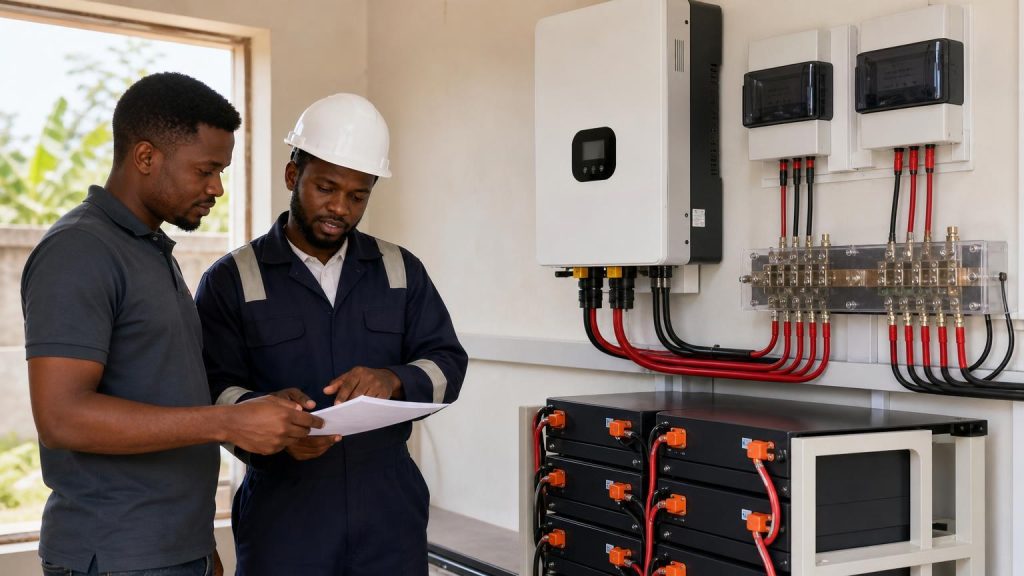
Before accepting a quotation, ask the installer to put the following information in writing:
| Quote item | What should be stated | Warning sign |
|---|---|---|
| Critical loads | Appliances or circuits, average load and backup hours | “Powers the whole house” with no load list |
| Inverter | Exact model, continuous watts, surge rating and battery voltage | Only “15kVA inverter” |
| Lithium battery | Exact model, nominal/usable kWh, discharge power and BMS limits | “25kWh battery” with no usable-energy or power detail |
| Lead-acid bank | Voltage, Ah, chemistry, quantity and series/parallel arrangement | Ah shown without voltage or quantity |
| Protection | Battery fuse/breaker, isolator, cable sizes, earthing and surge protection as required by the design | “All accessories” with no list |
| Commissioning | Settings, tests, serial numbers, manuals and handover | No written handover or warranty process |
For a wider quotation checklist, read How Do I Check Whether a Solar Quote Is Overpriced or Missing Important Parts in Nigeria? If the battery line itself is confusing, see How Do I Know If the Battery Capacity on a Solar Quote Is Correct?
Do not forget solar-panel recharge capacity
A large battery can give good night-time backup and still remain partly empty if the solar array cannot replace the energy used during the day. The proposal should show how many panels are included, their total wattage, the inverter’s PV-input limits and the expected charging window.
Nigerian heat, Harmattan dust, cloud cover, shading, roof orientation and system losses can reduce real solar production. Do not treat panel nameplate wattage as energy produced all day. Use the SolarPriceNG Solar Panel Calculator for a planning estimate, then ask the installer to explain the proposed panel string and recharge assumptions.
Safety and installation checks in Nigeria
Battery banks for a 15kVA inverter involve high DC currents and can cause serious damage if the voltage, polarity, cables or protection are wrong. Do not install, alter or test live battery and inverter connections yourself unless you are qualified and authorised to do so.
NEMSA is responsible for enforcing technical standards and carrying out inspection, testing and certification of electrical installations in Nigeria. Its official guidance and services also cover renewable-energy installations and certified electrical personnel. For a substantial home or business system, ask the installer who is responsible for the design, testing, protection, earthing and handover. You can review NEMSA’s technical standards and inspection information before approving the work.
A qualified installer should also confirm that the battery room or cabinet is dry, ventilated and protected from flooding, excessive heat and accidental contact. Keep battery cables short and properly supported, and never remove a fuse, breaker or battery-management protection to force the system to operate.
A practical decision rule
- List the critical appliances. Do not start with 15kVA; start with what must stay on during a blackout.
- Measure or estimate the simultaneous load. Include refrigerator, freezer, pump and air-conditioner starting requirements.
- Choose the backup hours. Four hours of essential loads is a different design from overnight or all-day backup.
- Convert the energy need into nominal storage. Show the usable-energy and inverter-efficiency assumptions.
- Check battery power and inverter compatibility. The battery must supply the current, voltage and starting demand safely.
- Check recharge. Make sure the panels, inverter charger and grid or generator charging plan can restore the battery.
- Approve only an itemised design. The quote should show equipment identity, protection, installation scope, warranty and exclusions.
For example, if your essential load averages 3kW for six hours, an illustrative 22.2kWh nominal lithium bank may be a starting point under the assumptions used above. If you later add a 2kW water heater or run a 1.5kW air-conditioner for several hours, the required storage changes. The battery is not “too small” or “too large” in isolation; it is correct or incorrect for a defined load and backup target.
Use SolarPriceNG’s Inverter Calculator to build the load list, then use the Battery Calculator to estimate storage. If you are buying a complete system, also ask the installer to demonstrate the checks described in What Should a Solar Installer Test Before Handover in Nigeria?
Final checklist
- I know the exact inverter model and its continuous watt rating.
- I have listed the critical appliances and their expected running time.
- I have separated battery energy capacity from battery discharge power.
- For lithium, I am comparing kWh and usable energy—not Ah alone.
- For tubular, GEL or AGM, I know the voltage, Ah, chemistry and bank configuration.
- The battery voltage, BMS settings and discharge limit match the inverter.
- The quote includes cables, fuses or breakers, isolators, earthing, installation and testing.
- The installer has explained how the solar panels or grid/generator charger will restore the battery.
- The promised backup time is tied to a written load and calculation.
The best battery for a 15kVA inverter is not the battery with the biggest number on the quotation. It is the battery bank that matches your actual Nigerian load, required backup hours, inverter voltage, discharge current, recharge plan and safety design.
All calculations in this guide are planning examples. Confirm the exact battery, inverter, cables, protection and installation design with the relevant manufacturer documentation and a competent professional before purchase or installation.