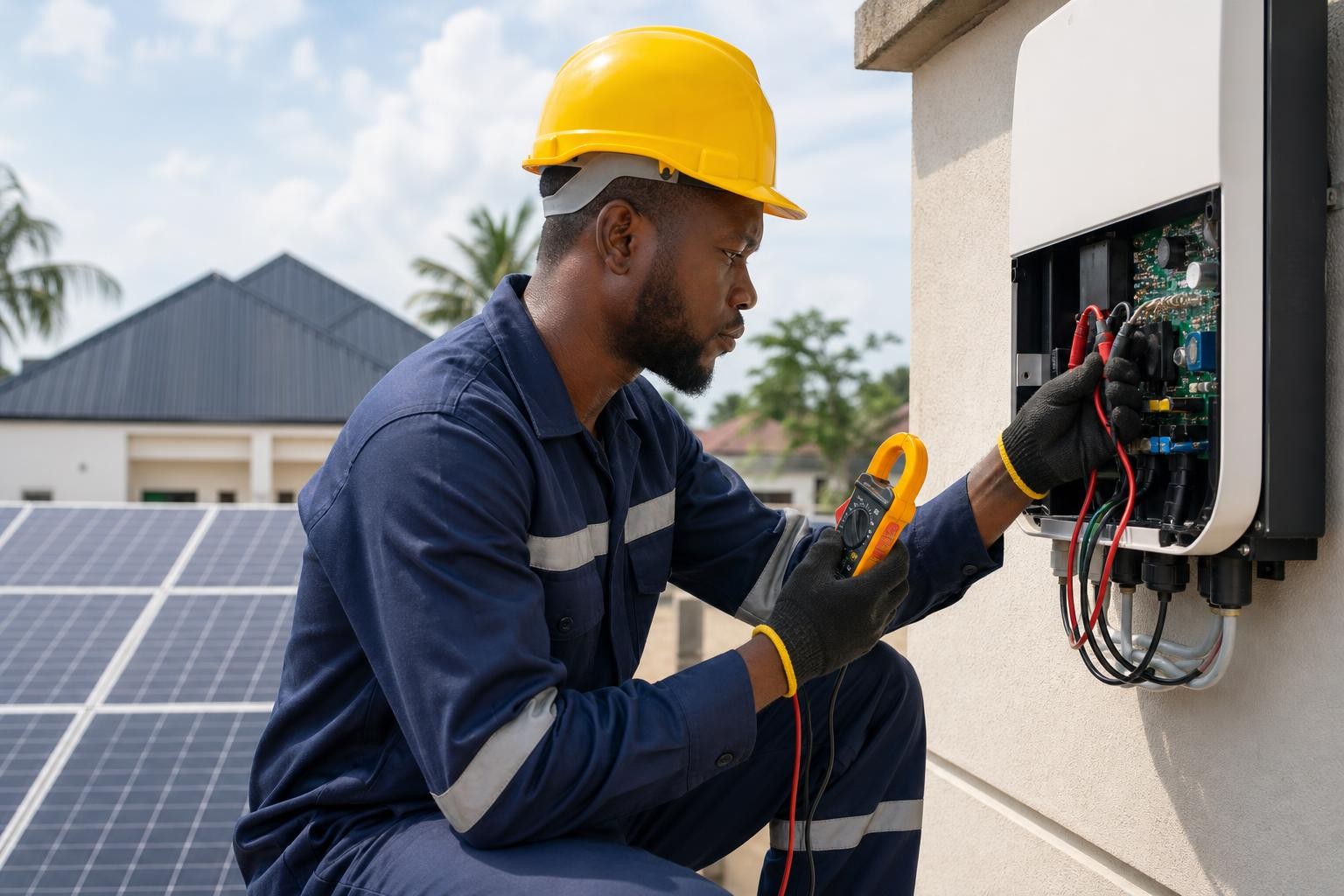
Last reviewed: September 24, 2026
Before you accept a new solar or inverter installation in Nigeria, the installer should test more than whether the lights come on. A proper handover should show that the system is connected safely, the solar panels are charging the battery, the inverter can carry the intended loads, the changeover works correctly, and you understand how to operate and maintain the equipment.
Quick answer: Before paying the final balance, ask the installer to demonstrate the backed-up circuits, solar charging, battery charging and discharge, grid or generator changeover, protection devices, earthing, monitoring, alarms and shutdown procedure. Ask for the exact equipment models, settings, serial numbers, warranties and a written record of the test results.
This checklist is for a normal home or small-business backup system. It is not a replacement for electrical inspection or commissioning by a qualified professional. Do not open live inverter cabinets, remove battery cables or measure exposed DC terminals yourself.
Why the handover test matters
A solar system can appear finished while important problems are still hidden. The panels may be installed but not charging the battery properly. The inverter may power small lights but trip when a refrigerator or pump starts. A changeover may leave an important circuit without backup, or protection and earthing may not have been completed as promised.
Handover is your opportunity to compare the installed work with the quotation and the actual job you requested. If you received a detailed quote, use it line by line. Confirm the equipment models, battery capacity, panel quantity, protection, cabling, mounting, backed-up circuits, installation scope and warranty terms. SolarPriceNG’s guide on how to check whether a solar quote is overpriced or missing important parts can help you review the original scope.
What should be tested before handover?
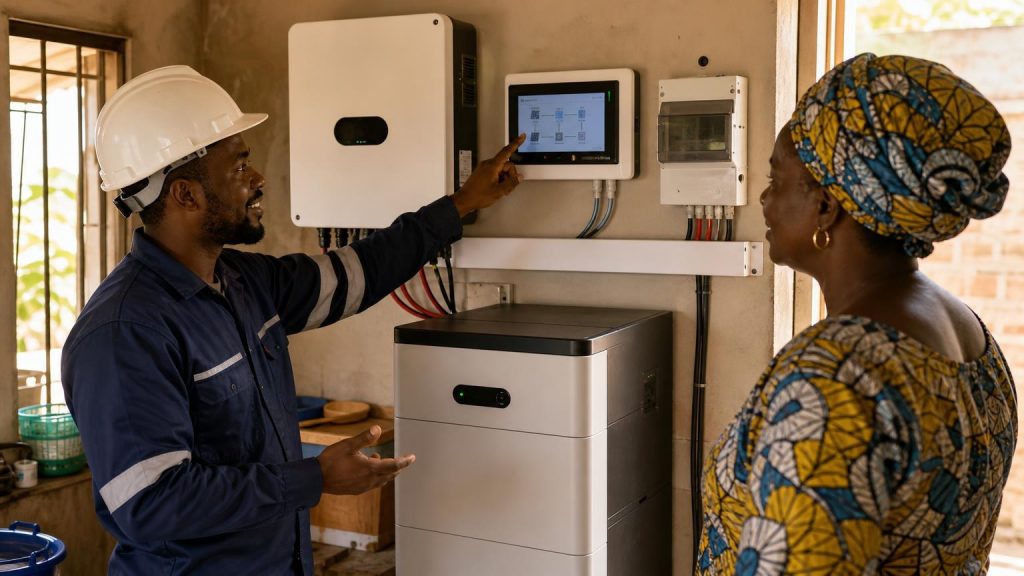
Ask the installer to demonstrate the following items while you observe and record the results. The exact readings depend on the equipment model, battery chemistry, weather and system design, so the installer should compare them with the manufacturer’s specifications rather than promising one universal number.
1. The backed-up circuits and appliance load
First confirm exactly what the system is meant to power. A home backup system may supply only selected circuits, such as lights, fans, television, internet equipment, CCTV, a refrigerator or a small office. It may not be designed to supply an electric cooker, water heater, air conditioner, borehole pump or every socket in the building.
- Switch on each agreed backed-up circuit and confirm that it is live.
- Confirm that circuits excluded from the backup are clearly identified.
- Test the normal appliances you intend to use, not only a phone charger or one light.
- Where safe and appropriate, start a refrigerator, freezer, pump or other motor load one at a time.
- Watch for overload, low-battery, short-circuit or over-temperature warnings.
Do not use a handover test as an excuse to connect every heavy appliance at once. The purpose is to confirm the agreed design. A system can have enough battery energy for a load over several hours but still lack the inverter power or starting surge needed to start a motor.
If you are unsure which appliances fit the inverter, prepare a load list first with the SolarPriceNG Inverter Calculator. It is a planning aid, so the final test should still use the exact inverter and appliance specifications.
2. Solar-panel production and charging
On a suitable daylight period, the installer should show that the panels are providing input to the inverter or charge controller. The displayed power will change with cloud, rain, dust, heat, shade, panel direction and the amount of energy being used by the appliances. A single midday number is not a guaranteed daily output, but there should be a sensible explanation of what the system is showing at the time.
- Confirm the panel quantity, wattage, brand and model against the quotation.
- Confirm that the panel strings are connected as designed and within the inverter or controller limits.
- Ask the installer to show the PV voltage, PV current or PV power on the display or monitoring system.
- Confirm that the battery receives charging current when the battery is below its normal charge limit and solar power is available.
- Ask what happens when the battery becomes full and where excess solar energy is directed or curtailed.
Do not accept “the panels are connected” as proof that the array is correctly commissioned. A panel problem, shade, incorrect string arrangement, loose connector or charge-controller limit can reduce charging even when the panels look neat on the roof. If output is already low, read what to check when solar panels produce low power.
3. Battery charging, discharge and capacity assumptions
The installer should explain how the battery is charged, what state-of-charge range is recommended, and which loads it can support for the expected period. Do not compare every battery using the same unit.
- Lithium batteries: use verified kWh as the main energy-capacity figure. Confirm the usable energy, maximum continuous discharge current, battery-management-system communication and the inverter settings.
- Tubular, GEL and AGM batteries: check Ah together with voltage, quantity, recommended discharge limit and the expected usable energy. Ah by itself is not enough.
Ask the installer to demonstrate that the battery is charging from the available sources and that the inverter can supply a reasonable agreed load from the battery. A full capacity test may take much longer than the handover appointment, especially for a large battery, so the installer should state whether the test is a short functional test or a measured capacity test.
For an illustrative check, a steady 1,000W critical load used for three hours requires about 3kWh of AC energy before allowing for inverter losses and battery limits. That does not mean a battery labelled 3kWh will deliver exactly three hours. Ask the installer to explain the assumptions used for your system and compare the expected result with the SolarPriceNG Battery Calculator.
4. Grid, generator and inverter changeover
Many Nigerian systems use more than one energy source: solar, battery, DisCo supply and sometimes a petrol or diesel generator. The installer should show how the system behaves when each source is available or unavailable.
- Show the normal operating mode when grid supply is present.
- Turn off or isolate the agreed source using the correct procedure and demonstrate the change to battery backup.
- Restore the source and confirm that the system returns safely without repeated tripping or unexpected interruption.
- If a generator is part of the design, demonstrate the generator input only according to the inverter and generator requirements.
- Confirm that the backup circuit cannot unintentionally energise a utility or generator supply that is meant to be isolated.
- Ask which loads are shed or delayed when the battery is low.
Do not bypass a changeover, connect a generator into a wall socket or improvise a backfeed connection. If the changeover behaves unexpectedly, stop the test and ask the installer to correct the wiring and explain the safe operating sequence.
5. Protection, earthing and visible installation quality
Protection devices are not decorative accessories. They help isolate equipment and reduce the risk of damage from faults, overcurrent or surges when correctly selected and installed. The exact design depends on the system voltage, current, cable route, equipment and local requirements.
- Ask the installer to identify the battery fuse or breaker, DC isolators, AC breakers and any surge-protection devices included in the design.
- Confirm that the labels identify what each isolator or breaker controls.
- Ask where the earthing and bonding connections are located and what was tested.
- Inspect for loose, exposed, crushed or badly supported cables, water entry and sharp edges.
- Check that battery terminals, cable lugs, enclosures and cable glands are protected from accidental contact and moisture.
- Confirm that the inverter has adequate ventilation and is not installed where heat, rain or flooding can damage it.
- Ask the installer to demonstrate the normal shutdown and isolation sequence.
You do not need to touch a live terminal to inspect workmanship. If you see burning, melting, exposed conductors, a swollen battery, an unusual smell or a hot cable, stop the handover and request professional correction.
What the installer should record before leaving
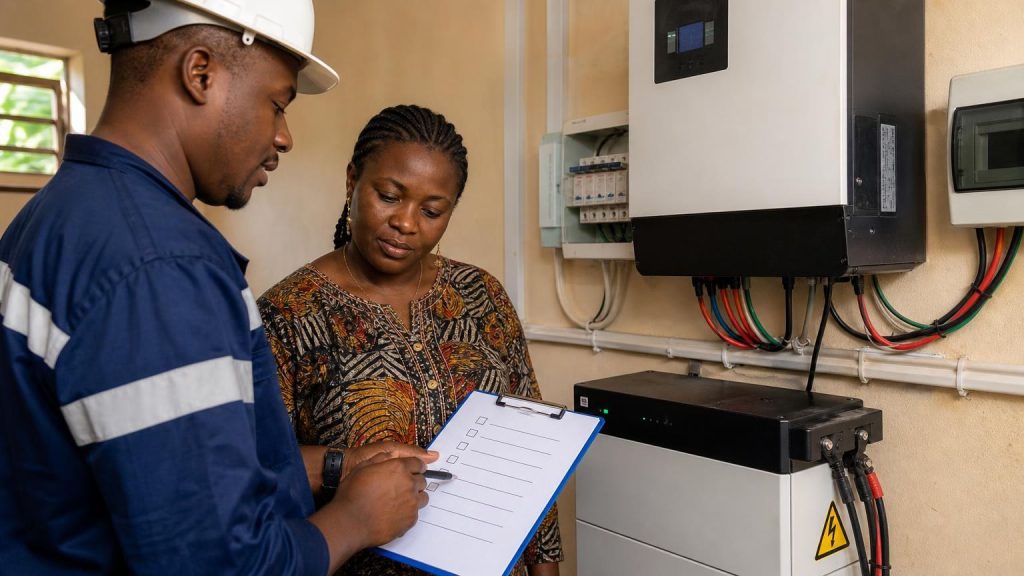
Ask for a simple commissioning and handover sheet. It should not hide behind vague words such as “tested OK”. The record should identify the equipment and state what was checked.
| Handover item | What should be recorded |
|---|---|
| Inverter | Brand, exact model, serial number, battery voltage, output rating and main operating mode |
| Battery | Brand, model, chemistry, voltage, kWh or Ah capacity, quantity, serial numbers and recommended operating limits |
| Panels | Brand/model, wattage, quantity, string arrangement and approximate array size |
| Protection | Breakers, fuses, isolators, surge protection, earthing and labels included |
| Functional test | Solar input, battery charging, battery discharge, backed-up load and source changeover |
| Monitoring | App or display setup, account access, alarm meanings and what data is recorded |
| Commercial terms | Product warranties, workmanship warranty, exclusions, service contact and payment balance |
Take photographs of the installed equipment, labels, serial numbers and distribution-board arrangement where the installer permits it. Keep the quotation, invoice, manuals, test sheet and warranty information together. These records can save time if you later need service or want to compare a fault with the original commissioning condition.
The monitoring system should be demonstrated
Many modern inverters and lithium batteries have a display, Wi-Fi dongle, mobile app or web portal. Do not leave the installation without knowing what the readings mean.
- Ask how to view solar power, battery state of charge, load power and energy history.
- Ask which reading shows the total solar energy produced in a day.
- Learn the difference between battery voltage, state of charge, charging current and usable energy.
- Ask what each common warning or alarm means for your exact model.
- Confirm who controls the monitoring account and how you regain access if the installer is unavailable.
- Ask whether the system continues to operate safely if internet or Wi-Fi is lost.
Monitoring is useful evidence, but it is not always a laboratory measurement. A battery percentage can be misconfigured, and a power reading can change when the battery is full or the appliances are using solar directly. Use the manufacturer’s manual and the installer’s explanation rather than relying on one number.
Ask for an operating lesson, not only a test
Before handover, the installer should explain the normal daily routine in plain language. You should know what to do during a blackout, when the battery is low, when the grid returns, when the generator is needed and when to call for help.
- Which appliances are safe to use during battery backup?
- Which appliances should not be connected or should be used only when grid or generator supply is available?
- What battery reserve or low-voltage setting should you respect?
- What should you do if the inverter beeps, shows overload or reports a battery fault?
- How often should panels, vents, cables and battery areas be inspected?
- Who should carry out cleaning, troubleshooting and electrical repairs?
- What action is safe during flooding, smoke, a burning smell or a damaged cable?
Never reset a repeated fault, bypass a breaker or change lithium-battery settings simply because the system stops working. If the inverter is beeping or the battery is not charging, use the relevant troubleshooting guide and contact a qualified installer when the safe external checks are complete.
When should you delay final acceptance?
You do not need to reject an entire installation because a minor label or document is missing, but you should record outstanding items and agree who will correct them and by what date. Delay final acceptance or the remaining payment when a serious safety or scope issue has not been resolved.
- The installed inverter, battery or panels do not match the agreed model or capacity.
- The backed-up circuits are different from the circuits you approved.
- The installer cannot demonstrate solar charging, battery charging or the agreed changeover.
- Protection, earthing, cables or enclosures are incomplete or visibly unsafe.
- The system trips under a normal agreed load and no explanation or correction is provided.
- There are signs of heat, burning, exposed conductors, water entry, battery damage or repeated fault codes.
- You have no written warranty, equipment identity, operating instructions or service contact.
Put defects in writing with photographs where appropriate. A clear list is more useful than a general message saying “the solar is not working well”.
A simple Nigerian home handover checklist
- Do I know exactly which circuits are backed up?
- Can the installer show solar input and battery charging in daylight?
- Can the system run the agreed lights, fans, internet equipment, television, refrigeration or office loads?
- Has the grid or generator changeover been demonstrated safely?
- Are battery, panel and inverter models recorded?
- Are the battery capacity and usable-energy assumptions explained?
- Are breakers, fuses, isolators, surge protection, earthing and labels complete?
- Do I know how to read the inverter or monitoring app?
- Do I have manuals, warranties, serial numbers and a service contact?
- Are all outstanding defects written down with a correction date?
If the installer says a test cannot be performed because of weather, a full battery, missing grid supply or another valid limitation, ask for the reason to be recorded and arrange a follow-up test when the condition is suitable. Do not treat an unperformed test as a successful test.
Bottom line
A good solar handover proves three things: the system matches the agreed design, it operates safely with the intended loads, and you have enough information to use and maintain it. Ask the installer to demonstrate the panels, battery, inverter, changeover, protection, monitoring and shutdown procedure, then collect a written record of the equipment and results.
Do not judge the installation only by whether electricity is available on the day. A system that powers one light may still have an undersized battery, incomplete protection, the wrong changeover arrangement or a panel-string problem. Complete the handover checklist, record any defects and use a qualified professional for tests or repairs involving live solar and battery wiring.
For a broader planning check, see how SolarPriceNG calculators work, and use the exact inverter and battery manuals when deciding what your installed system should safely do.