Last reviewed: September 25, 2026
If your generator is running but your inverter is not charging the battery, do not assume that the generator is completely faulty. The most common causes are an overloaded or undersized generator, unstable voltage or frequency, a breaker or changeover problem, a disabled AC-charging setting, an already-full battery, or a fault in the inverter’s AC charger.
The quickest way to narrow it down is to follow the power path:
Generator → AC input and protection → Inverter charger → Battery
Start by checking whether the inverter detects the generator’s AC input. If it does not, investigate the generator output, breaker, changeover switch and wiring. If it detects AC but will not charge, check generator stability, load, charging settings and battery status. Leave internal electrical testing and repairs to a qualified technician.
How a Generator Charges an Inverter Battery
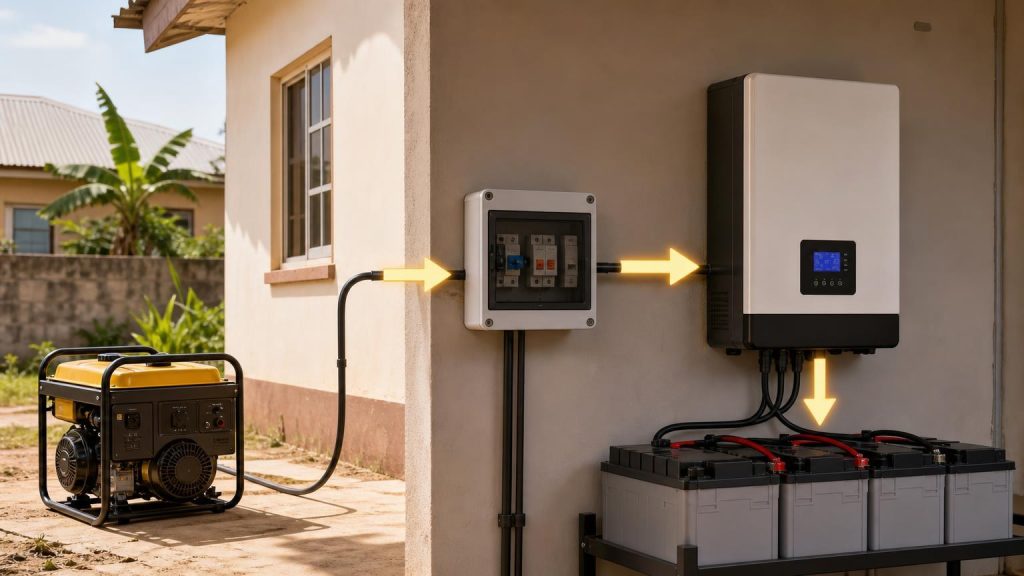
A generator does not normally charge the battery directly. It produces AC electricity, which enters the inverter’s AC input. The inverter’s built-in charger then converts that AC power into the DC power needed by the battery.
That means a generator can power a light or television and still fail to charge the battery. The inverter may reject the generator because the voltage, frequency, waveform, available capacity or connection is not suitable.
Many Nigerian household systems are based around 230V and 50Hz, but the acceptable input range is model-specific. Always compare the generator output with the inverter manual instead of assuming that every generator and inverter will work together.
The Most Likely Causes
1. The generator is too small or overloaded
The generator must supply the appliances connected to it and the inverter’s AC charger at the same time. It also needs spare capacity for starting loads from refrigerators, freezers, water pumps and air conditioners.
For example, if your appliances are using about 1,500W and the inverter charger is trying to draw another 1,000W, the generator must handle roughly 2,500W before allowing for motor starting surges and normal operating headroom. A generator that can run a few lights may struggle when the inverter begins charging a low battery.
Do not match the generator to the inverter’s headline kVA rating alone. Check the inverter’s maximum AC charging power, the generator’s usable kW output and the loads that will run during charging. kVA and kW are related but are not always identical.
Safe check
Switch off unnecessary heavy loads and allow the generator to run with the inverter connected. If charging begins, reconnect appliances one at a time. If charging stops when a pump, freezer or air conditioner starts, overload or starting surge is a strong possibility.
2. Generator voltage is outside the inverter’s accepted range
A generator may be running while its output voltage is too low, too high or fluctuating too much for the inverter. Overloading, engine problems, a failing automatic voltage regulator (AVR), poor maintenance or a loose connection can cause this.
The voltage may look acceptable with no load and then fall when the inverter charger starts. This is why a generator can appear to work normally until you connect the inverter.
If you have the correct test equipment and training, a qualified person can check the generator output at no load and under load. Do not open the generator or inverter cabinet, hold exposed probes near live terminals or attempt internal repairs if you are not trained.
3. Generator frequency is unstable
Inverters commonly check frequency as well as voltage. In a 230V/50Hz system, an engine that hunts, slows down or changes speed under load can push the generator frequency outside the inverter’s acceptance range.
A typical symptom is:
AC detected → AC rejected → charging stops → AC detected again
This repeated clicking or changing status does not necessarily mean the battery is bad. It may mean the generator cannot maintain stable power. Have the generator serviced and its output tested rather than repeatedly forcing the inverter to accept it.
4. The generator is connected to the house but not to the inverter AC input
If the generator powers some appliances but the inverter display shows no AC input, inspect the simple parts of the supply path first:
- Generator output breaker
- Inverter AC-input breaker
- Changeover or transfer switch position
- Loose or damaged cable
- Tripped protection device
- Incorrect connection at the inverter’s AC input
Only check switches and breakers that you can operate safely from outside the equipment. Do not bypass a breaker, join wires temporarily or alter neutral and earth connections to make the inverter charge.
5. AC charging is disabled or limited in the inverter settings
Many hybrid and off-grid inverters have separate settings for AC charging, charging-source priority, maximum AC charging current, generator input and charging schedules. A previous installer or user may have disabled utility/generator charging or reduced the charging current to a very low value.
Check the display or app for signs that the inverter sees AC input but is not charging. Read the manual for your exact model before changing settings. Lithium systems require compatible charging limits and battery-management settings; do not copy settings from a different battery chemistry.
6. Solar priority or the operating mode makes the charging look different
Some hybrid inverters prioritise solar energy or use different charging modes depending on the time, battery state and selected source priority. During the day, solar may be supplying the load while the generator is detected but contributing little or no battery charge.
Look at the inverter display for separate readings for PV input, AC input, load power, battery current and charging status. The important question is not only whether the generator is running, but whether the inverter is actually accepting its AC power and sending charging current to the battery.
7. The battery is near full or its protection system is limiting charge
Charging current normally reduces as a battery approaches its target voltage or state of charge. A lithium battery may also limit or stop charging through its battery-management system if temperature, voltage or another protection condition is outside its safe range.
Check the battery percentage, battery voltage and charging current shown by the inverter. A low or zero charging current is not automatically a fault if the battery is already full or the charger has moved into a lower-current stage.
8. The inverter’s AC charger or input section has failed
If the generator has stable output, the inverter detects AC, the settings are correct and the battery still does not charge, the inverter’s AC charging section may be faulty. The same suspicion becomes stronger if the inverter also refuses to charge from another suitable AC source.
Do not open the inverter to confirm this yourself. Internal capacitors and other parts can remain dangerous even after the generator is switched off. A qualified solar technician should test the system and explain whether the fault is in the generator, wiring, inverter or battery.
Quick Diagnosis: What the Symptom Suggests
| What you observe | Likely area to investigate |
|---|---|
| Generator powers appliances but inverter shows no AC input | Breaker, changeover, cable, AC input connection or incompatible output |
| Inverter detects AC, then rejects it repeatedly | Voltage/frequency instability, overload or generator compatibility |
| Charging starts after heavy appliances are switched off | Generator capacity, charging-current limit or starting surge |
| Inverter charges from another suitable AC source but not the generator | Generator output, waveform, frequency or generator-to-inverter connection |
| Inverter will not charge from the generator or another suitable AC source | Charging setting, battery condition or inverter charger fault |
| Charging current is low while the battery is nearly full | Normal charge-stage reduction or battery-management limit |
What to Check First: A Safe Order
Use this order so that you do not start by replacing expensive equipment:
- Read the inverter display. Confirm whether it shows AC input, a charging symbol, an error code or an input-out-of-range warning.
- Reduce the generator load. Temporarily switch off high-demand appliances and observe whether charging starts.
- Check external breakers and the changeover position. Do not remove covers or bypass protection.
- Confirm the generator is suitable. Check its voltage, frequency, usable power and the inverter’s AC-input requirements in the manuals.
- Check AC-charging settings. Confirm that generator/utility charging is enabled and that the current limit is not set too low.
- Check battery status. A full battery, high temperature or battery-management protection can reduce or stop charging.
- Arrange professional testing. If the fault remains, have a qualified technician measure the generator and inverter input under load.
If your wider problem is that the battery is not charging from any source, read Solar Inverter Not Charging the Battery: Causes and What to Check. If you are unsure whether the battery or inverter is failing, see How Do I Know If My Solar Battery Is Bad or the Inverter Is the Problem?
Can a Small Generator Charge an Inverter?
Yes, but only if its usable output is enough for the inverter’s charging demand and the appliances running at the same time. The practical estimate is:
Required generator capacity ≈ appliance running load + inverter AC charging load + starting-load headroom
This is a planning estimate, not a substitute for the inverter and generator manuals. A 5kVA inverter does not automatically need a 5kVA generator, because the inverter may be configured to charge at a much lower power. On the other hand, a small generator may still fail if the charging current is high or a motor load starts at the same time.
When planning a new installation, write down the appliances that will run during generator charging, their running watts and any starting or surge demand. SolarPriceNG’s calculator guide explains how to use system calculations to make better sizing decisions, although the final generator-to-inverter connection should still be checked against the equipment manuals.
Can a Stabilizer Fix the Problem?
Not automatically. A suitable regulation device may help with a voltage problem in some installations, but it cannot correct an undersized generator, unstable frequency, wrong wiring, disabled charging, a damaged inverter charger or an unsuitable waveform.
Do not buy or connect a stabilizer simply because someone says it will make any generator work with any inverter. First identify whether the problem is voltage, frequency, capacity, connection, settings or equipment failure. A qualified installer should confirm compatibility before another device is added.
When to Stop and Call a Qualified Technician
- You smell burning, see smoke or notice melted insulation.
- You see sparks, exposed conductors or damaged cables.
- A breaker trips repeatedly.
- The generator engine hunts badly or its output is visibly unstable.
- The inverter shows a serious electrical fault or overheats.
- The battery is swollen, leaking, unusually hot or physically damaged.
- You need to measure live AC terminals or open a generator, changeover box or inverter.
- You are not certain which breaker, cable or terminal is safe to touch.
Generator and inverter systems contain hazardous AC and DC energy. Never bypass fuses, breakers, earthing or other protective devices to force charging. If the installation itself needs checking, use a properly qualified solar installer or electrician. For a broader installation handover checklist, see What Should a Solar Installer Test Before Handover in Nigeria?
Final Answer
Your generator may be running without charging the inverter because the inverter is not receiving acceptable AC power, the generator is overloaded, the connection is interrupted, AC charging is disabled, the battery is already near full, or the inverter’s charger has a fault.
Check the inverter display first, then reduce the generator load, inspect only the external breakers and changeover position, confirm the generator’s voltage and frequency are suitable, and review the charging settings. If the inverter still will not charge, stop before opening equipment and arrange professional testing.