
Last reviewed: September 28, 2026
Short answer: do not replace the battery or inverter just because the system shows a low-battery alarm or gives less backup than before. First reduce the load, record the exact warning, confirm that the battery is charging, and compare what happens at the battery terminals with what the inverter sees. A battery that loses voltage quickly under a controlled load or cannot hold charge after proper charging is more suspicious. A healthy battery paired with low voltage at the inverter, repeated overload or temperature faults, no AC output, or an internal error points more towards the cables, charger, settings or inverter.
This guide is for Nigerian homes, shops and small offices using solar, inverter, generator and grid power. It covers safe external checks. Do not open an inverter, bypass a fuse or work on high-current DC or live AC wiring yourself.
Battery problem, inverter problem or something in between?
The battery and inverter work as one system, so one symptom can have several causes. A “low battery” warning may mean the battery is genuinely empty, but it can also be caused by a heavy appliance, a motor starting, a loose terminal, an undersized cable, a blown or weak fuse connection, a wrong battery setting, a charger that is not replenishing the battery, or a lithium battery management system (BMS) protection event.
Before buying a replacement part, separate these three questions:
- Can the inverter supply the appliance? This depends on continuous output and starting or surge capacity.
- Can the battery supply that power without excessive voltage drop? This depends on battery condition, discharge limits, wiring and connections.
- Can the charging system replace the energy used? This depends on solar production, grid or generator charging, settings, daytime loads and the battery’s condition.
A fault in any one of these areas can make another component look bad.
Start by recording the exact symptom
“The solar is not working” is too broad to diagnose. Before resetting the system, take a photo of the inverter display or monitoring app and note:
- the exact alarm, error code or indicator-light pattern;
- whether the problem happens during a blackout, while grid power is available, or with the generator running;
- which appliances were operating when the fault occurred;
- how long the system ran after its last proper charge;
- whether the battery charges from solar, grid and generator input;
- the battery chemistry: lithium, tubular, AGM, GEL or another type;
- any heat, smell, swelling, leakage, melted insulation or unusual sound.
The timing is useful. A shutdown immediately after a freezer, pump or air conditioner starts suggests starting surge, overload, battery output or voltage drop. A shutdown after several hours of normal use suggests depleted energy, reduced battery capacity, incomplete charging or a larger hidden load. A dead display with the correct battery voltage reaching the inverter raises more suspicion of a protection, DC supply or inverter fault.
A safe first test
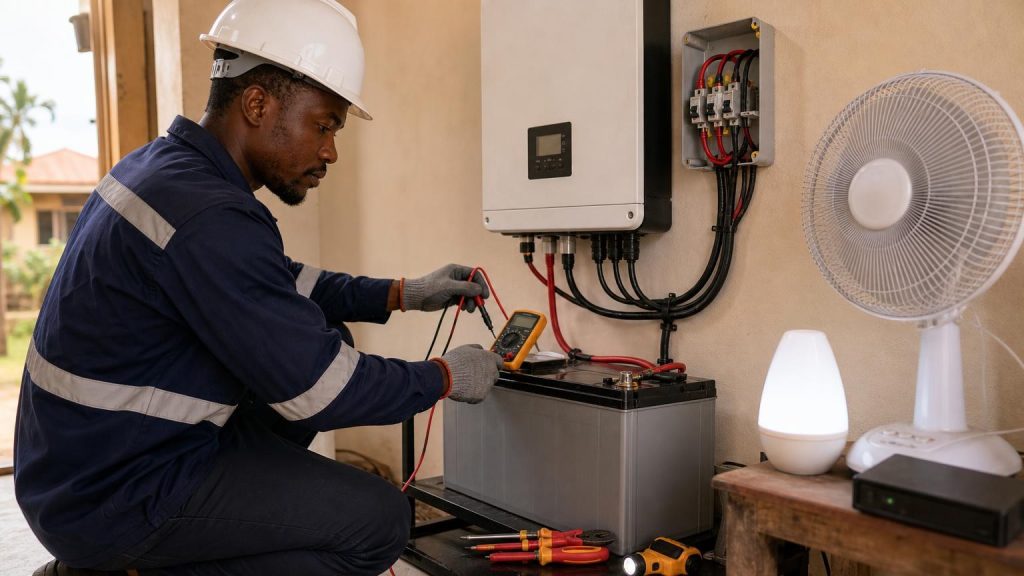
1. Remove heavy loads
Switch off non-essential appliances and test with a small, steady load such as a few LED lights, a fan, television or router. Do not use an air conditioner, electric iron, kettle, microwave, water heater, pump or large freezer as the first test.
If the inverter works with the small load but shuts down when a larger appliance starts, investigate the appliance’s starting demand, the inverter’s surge rating, the battery voltage under load and the DC cable path. This pattern does not prove that the inverter or battery has failed.
2. Check the inverter warning before resetting it
Use the manual for the exact inverter model. Different brands use different codes and beep patterns. A low-battery warning, overload warning, high-temperature warning, high-DC-ripple warning and internal fault require different checks.
A low-battery alarm tells you that the inverter is seeing a low input voltage. It does not, by itself, prove that the battery is damaged. The voltage at the inverter can be pulled down by a weak battery, a large load, a poor cable or a bad connection.
3. Confirm that the battery is actually charging
A battery that begins the night partly charged can look like a worn-out battery. Check whether the system reaches its normal charging stage and whether the battery state of charge or charging current rises when a suitable source is available.
- With solar, check PV power and charging current during good sunlight. Cloud, rain, Harmattan dust, shade, heat, damaged wiring and daytime appliances can reduce the surplus available for charging.
- With grid or generator input, check whether the inverter’s AC charger is enabled and whether it accepts that input.
- For lithium, check the battery display or approved monitoring app for BMS, temperature, cell or communication warnings.
- For tubular or flooded lead-acid, follow the maker’s instructions for water level, ventilation and charging. Never add acid simply because the battery is weak.
For example, if the solar array is producing 1,500W while daytime appliances are using 1,800W, the battery may still be discharging even though the sun is shining. That is a charging-energy problem, not automatically a bad battery.
If the battery is not charging, see Why Is My Solar Battery Not Charging? Causes and What to Check.
4. Inspect only the safe, visible parts
Without removing covers or touching exposed conductors, check whether:
- a battery or inverter isolator is in the expected position;
- a breaker has tripped or a fuse indicator has changed;
- terminals look loose, corroded, discoloured or melted;
- battery or inverter cables are unusually hot;
- dust, clothing or a box is blocking inverter ventilation;
- a battery is swollen, cracked, leaking or giving off an unusual smell;
- a lithium BMS display or app shows a protection warning.
Do not keep resetting a breaker that trips again. Do not replace a fuse with a larger one and do not bypass a lithium battery’s BMS.
How to separate a battery problem from a cable problem
A battery can be healthy while the inverter sees low voltage because power is being lost between them. Common causes include a long or undersized cable, loose lugs, corrosion, a damaged fuse holder or a poor isolator connection.
A qualified technician can compare:
- voltage directly at the battery terminals; and
- voltage at the inverter’s DC input terminals.
The comparison should be made at rest and, where safe, while a known load is operating. If the battery voltage remains reasonable but the inverter-side voltage drops much lower under load, the DC path deserves attention. If the voltage falls at the battery terminals itself, the battery or its ability to supply the load becomes more suspicious.
This is a high-current measurement. Do not loosen, move or tighten battery cables while the system is energised. DC arcs can cause burns, fire and equipment damage.
What signs suggest that the battery is weak?
No single reading proves that a battery is bad. Several signs together are more meaningful:
- Backup time has become much shorter with the same measured load.
- The battery reaches “full” unusually quickly but also becomes empty unusually quickly.
- Its voltage looks reasonable with no load but falls sharply when a modest, steady load is connected.
- It cannot hold charge after it has been correctly charged and rested according to the maker’s procedure.
- One battery in a series or parallel bank behaves differently from the others.
- A lead-acid battery is swollen, leaking, persistently hot or badly corroded.
- A lithium battery repeatedly reports BMS, cell-imbalance, temperature or communication faults.
A resting-voltage reading is only one clue. A battery may show a reasonable voltage immediately after charging because of surface charge, then fall quickly under load. A proper load or capacity test is more useful than replacing the battery from one meter reading.
What signs suggest that the inverter, charger or wiring is the problem?
Look beyond the battery when:
- the battery voltage is healthy at its terminals but much lower at the inverter under load;
- the inverter reports overload even after large appliances are disconnected;
- the inverter overheats with a modest load or has blocked ventilation;
- the battery charges from one source but not another;
- the inverter shows repeated high-DC-ripple, communication or internal-fault warnings;
- there is no AC output with no load and a correctly charged battery;
- the battery type, low-voltage cut-off or charging settings do not match the manufacturer’s requirements.
Some inverter manuals specifically direct technicians to check the battery, cable thickness, cable connections, fuses and load when low-battery or DC-ripple alarms occur. That is why an inverter warning should start a diagnosis, not end it.
Use the correct checks for the battery chemistry
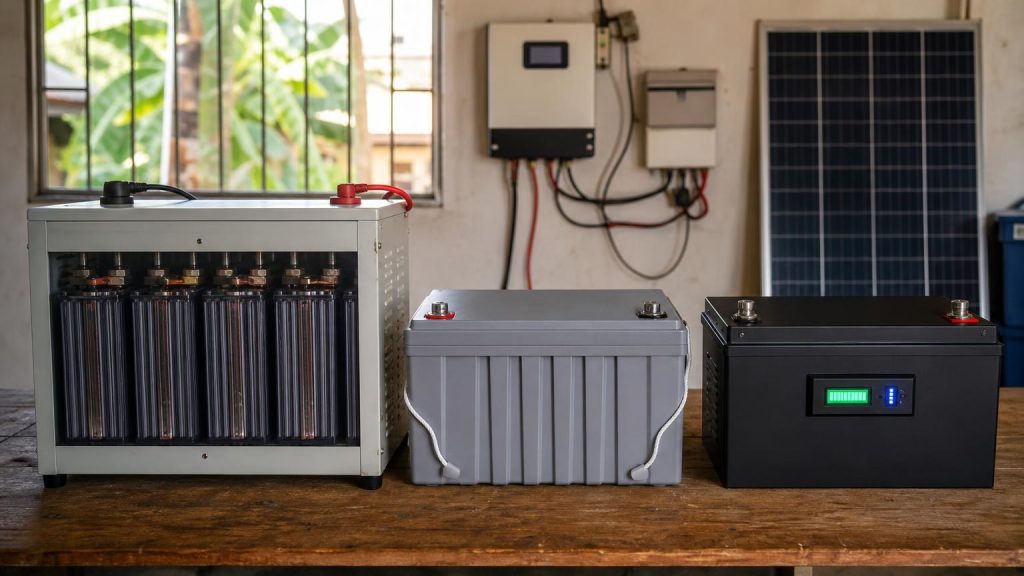
| Battery type | Useful checks | Do not do this |
|---|---|---|
| Tubular or flooded lead-acid | Rested voltage, water level, terminal condition, specific gravity where appropriate, and a proper load or capacity test. | Do not add acid casually, operate without ventilation or allow plates to remain exposed. |
| AGM or GEL | Charging behaviour, rested voltage, terminal voltage under load and a maker-approved test. | Do not open the case or treat it like a refillable flooded battery. |
| Lithium | BMS or app status, state of charge, voltage, current, temperature, fault history and correct charger/inverter communication. | Do not bypass the BMS or change charge limits blindly. |
Use the right capacity unit too. Lithium batteries are primarily compared by usable kWh when that is the verified specification. Tubular, AGM and GEL batteries are usually described in Ah together with voltage. Comparing lithium and lead-acid by Ah alone can give the wrong answer.
Quick decision table
| What you observe | What it points towards | Next safe action |
|---|---|---|
| Inverter runs lights but trips when a freezer, pump or AC starts | Starting surge, overload, weak battery or voltage drop | Reduce simultaneous load and have the appliance surge demand and DC path checked. |
| Battery voltage is normal at the battery but low at the inverter | Cable, fuse, isolator or terminal resistance | Have a qualified installer test the complete DC path under load. |
| Battery charges but runtime is much shorter than before | Capacity loss, larger load or incomplete charging | Record the load and runtime, confirm full charge, then arrange a proper battery test. |
| Battery never reaches charge from solar | Panel, controller, shading, wiring, settings or battery fault | Check PV conditions and charging current without bypassing protection. |
| Battery remains healthy but inverter faults with no load | Inverter, settings, temperature or internal protection | Record the exact code and contact the installer or manufacturer. |
| Lithium battery suddenly disappears from the system | BMS protection or communication/charging issue | Use the approved monitoring and recovery procedure for that battery. |
Do not confuse inverter power with battery energy
The inverter determines how much power can be delivered at one moment. The battery determines how much energy is available over time.
Energy needed = load in watts × time in hours.
A 500W load used for 4 hours needs about 2,000Wh, or 2kWh, before allowing for inverter losses and battery limits. That simple calculation does not prove that a battery or inverter is faulty, but it can reveal that the original system was undersized for the appliances being used.
A larger inverter does not automatically make the battery large enough. A larger battery also cannot make an undersized inverter safely run a heavy appliance. Use the SolarPriceNG Battery Calculator as a planning aid, then confirm the result against the exact equipment specifications.
A Nigerian home example
Imagine a home in Ibadan, Enugu or Abuja where the system used to run lights, fans, a television and a router through most of the evening. It now shuts down when the refrigerator starts.
- Record the inverter warning and battery reading before resetting anything.
- Switch off the refrigerator and test the smaller load.
- If the inverter remains on, check the refrigerator’s starting demand and the inverter’s surge rating.
- Have the technician measure voltage at the battery and inverter while the refrigerator starts.
- Compare the battery’s tested capacity with the energy required by the evening load.
If the voltage collapses only at the inverter because of a hot or loose cable, a new battery will not solve the problem. If the voltage falls at the battery itself and the battery has lost capacity, the battery may need replacement. If both readings stay healthy but the inverter reports an internal or output fault, the inverter deserves service.
If your system is beeping, also read Why Is My Solar Inverter Beeping? Common Causes and What to Check. If the shutdown happens mainly at night, see Solar Inverter Shuts Down at Night: Causes and What to Check.
When to stop troubleshooting
Stop and call a qualified solar technician or electrician if you see:
- smoke, burning smell, melted insulation or visible arcing;
- swelling, leakage, cracking or unusual heat from a battery;
- hot battery terminals or cables;
- a fuse or breaker that trips repeatedly;
- a lithium BMS fault that does not clear through the manufacturer’s normal procedure;
- an inverter that remains dead or shows an internal fault after safe external checks;
- a need to open the inverter, change battery connections or work on live AC equipment.
Do not short battery terminals, touch wires together as a test, bypass low-voltage protection or copy charging settings from another battery. Battery banks can deliver enough current to cause fire, burns and serious injury.
What to record before requesting service
- Battery make, model, chemistry, voltage and capacity.
- Inverter make, model and exact fault code or LED pattern.
- Battery voltage at rest and under the test load, if measured safely.
- Voltage at the battery and inverter terminals, if tested by a qualified person.
- Appliances running when the fault occurred.
- How long the system ran after a proper charge.
- Whether grid, generator and solar each charge the battery normally.
- Photos of labels and displays, but not exposed live conductors.
Bottom line
You are more likely to have a battery or battery-connection problem when backup time has reduced, the battery voltage collapses under a controlled load, or the inverter reports low voltage only when the load increases. You are more likely to have an inverter problem when the battery and DC supply are verified but the inverter has no output, repeated internal faults or charging/output failures with a small load.
The most reliable and cost-effective order is: record the symptom, reduce the load, confirm charging, inspect safe external parts, compare battery and inverter-side voltage under a controlled test, then arrange a proper battery or inverter test. Do not buy a replacement part until the complete system path has been checked.
Technical references
These checks should always be adapted to the exact equipment manual. Manufacturer troubleshooting guidance commonly treats low battery, overload, high temperature, cable voltage drop and internal faults as separate possibilities:
- Victron Energy inverter operation and fault guidance
- Victron Energy battery-cable voltage-drop troubleshooting
- Trojan Battery maintenance guidance