Last reviewed: September 25, 2026
If your solar system is no longer lasting long enough, the cheapest fix is not automatically a bigger battery or more solar panels. In many Nigerian homes, the best first move is to reduce the load you run during an outage or move some usage to daylight. In other cases, the existing panels are not producing enough energy, or the battery is too small for the evening load.
Short answer: reduce the load first when you can remove non-essential consumption without losing the service you need. Add more solar panels when the battery is not recovering during the day. Add battery capacity when the panels already fill the existing battery, but stored energy runs out before the next charging window. If the system is not charging or producing normally, test and repair it before buying anything.
The right comparison is not simply the price of three pieces of equipment. It is the cost of solving the actual problem: how many useful watt-hours you need, when you need them, and whether your inverter, charge controller, wiring and protection can support the change.
What each option actually fixes
| Option | What it adds or removes | Usually makes sense when… |
|---|---|---|
| Reduce the load | Uses less energy and may lower the highest simultaneous wattage | You can switch off, shorten or reschedule non-essential appliances |
| Add solar panels | Collects more energy during daylight | The battery stays partly charged or takes too long to recover |
| Add battery capacity | Stores more energy for evening and night use | The existing battery fills before evening but runs out overnight |
| Repair or test first | Restores lost performance without changing the system size | Solar input, charging, battery voltage or inverter behaviour is abnormal |
A larger battery cannot create energy that the panels do not collect. More panels cannot give longer night-time backup if the battery cannot store the extra energy. Reducing the load can be the lowest-cost option, but only if the reduced load still covers what you genuinely need during a blackout.
Step 1: Find out whether the problem is energy, storage or a fault
Before comparing quotations, observe the system for several normal days. Record:
- the battery state of charge or voltage in the morning;
- the highest solar power shown around the strongest sunlight;
- the time the battery reaches full charge, if it reaches full charge;
- the appliances running while the battery is charging;
- the time the battery reaches its low-voltage or minimum state-of-charge limit; and
- whether a fridge, freezer, pump, pressing iron or other motor or heating appliance causes a trip or alarm.
These observations separate three common situations:
- Battery is low at sunset: the system may need more solar generation, less daytime consumption, a charging repair or all three.
- Battery is full in the afternoon but empty overnight: storage or night-time load is more likely to be the constraint.
- Solar power or battery readings are abnormal: test the system before purchasing an upgrade. Dust, shade, a loose connection, incorrect settings, a failed charger or an ageing battery can imitate a sizing problem.
If your battery is not charging or the inverter is showing unusual alarms, start with how to distinguish a bad solar battery from an inverter problem. Buying a bigger battery to hide a charging fault usually increases the cost without solving the cause.
When reducing your load is the cheapest answer
Load reduction means using fewer appliances, using them for fewer hours, or moving flexible usage to the daytime when solar power is available. It is often the cheapest option because it may require no new hardware.
For example, a home may keep lights, fans, internet equipment, television and refrigeration on backup, while leaving an electric cooker, pressing iron, water heater, large pump or air conditioner off during a short outage. A small office or POS shop may prioritise the router, phone charging, laptop, lights and security equipment instead of trying to run every appliance.
Use this calculation for each appliance:
Energy used = appliance power in watts × hours used ÷ 1,000
Suppose two fans are each assumed to use 60W and you reduce their combined use by two hours:
2 × 60W × 2 hours ÷ 1,000 = 0.24kWh saved
That saving is only an illustration. Check the actual appliance label or measure the appliance where possible. A refrigerator, freezer or pump does not draw its nameplate power continuously, while its starting demand can be much higher than its running demand.
Load reduction is especially attractive when:
- the extra appliance is not essential during the outage;
- the main problem is a short evening peak rather than an all-night energy shortage;
- your inverter is close to its continuous or surge limit; or
- you need a temporary solution while saving for a properly designed upgrade.
Do not remove essential protection, overload the remaining circuits or improvise a changeover arrangement. If you need a safer way to keep only essential appliances running, see the critical-appliance guide for blackouts in Nigeria.
When adding more solar panels is better
More panels are usually the better investment when the system lacks daily energy. The clearest sign is that the battery is still partly charged when the sun goes down, or it takes several good days to recover after an outage.
More PV may be appropriate if:
- the battery rarely reaches full charge on a clear day;
- daytime appliances consume most of the available solar energy;
- the system takes too long to recover after cloudy or rainy weather;
- panels are dirty, shaded, poorly oriented or too few for the daily energy requirement; or
- you want to run more useful daytime loads without discharging the battery.
A planning estimate is:
Daily solar energy ≈ panel capacity in kW × equivalent sun hours × overall system factor
For an illustration, a 2kW array with an assumed four equivalent sun-hours and an assumed 75% factor would produce:
2kW × 4 × 0.75 = about 6kWh per day
This is not a promise for every Nigerian location or every season. Heat, cloud, rain, Harmattan dust, shading, orientation, wiring, controller limits and inverter conversion affect the result. Use your own monitoring data where available.
Before adding panels, check the inverter or MPPT controller’s maximum PV voltage, current, recommended wattage and panel-string requirements. Do not combine panels only because their wattage numbers look similar. SolarPriceNG explains the compatibility checks in Can I add different-wattage solar panels to my existing system?
When adding a bigger battery is better
A bigger battery is more likely to be the right choice when the solar array already supplies enough energy and the battery reaches full charge before evening, but the stored energy runs out during the night.
Use this rough storage check:
Required usable battery energy ≈ night-time load in kW × required hours
Then allow for the battery’s usable-energy limit and inverter losses when converting that requirement into a nominal battery size. Lithium batteries should be compared primarily by verified kWh and usable capacity. Tubular, GEL and AGM batteries should be checked using Ah together with voltage, chemistry, recommended discharge limit and the complete bank configuration.
For example, suppose a critical-load plan uses an average 450W from 7 p.m. to 5 a.m.:
0.45kW × 10 hours = 4.5kWh of AC load energy
The battery would need more than 4.5kWh of nominal storage because some energy remains reserved and some is lost in the inverter. The exact allowance depends on the battery model, chemistry, discharge rate, temperature, inverter efficiency and installation settings. Do not turn this example into a guarantee or copy a generic percentage to every battery.
A larger battery is not the first answer if the existing battery never reaches full charge. It gives you more storage to fill, which can make recovery slower unless the solar array is expanded at the same time.
Worked comparison: three possible upgrades
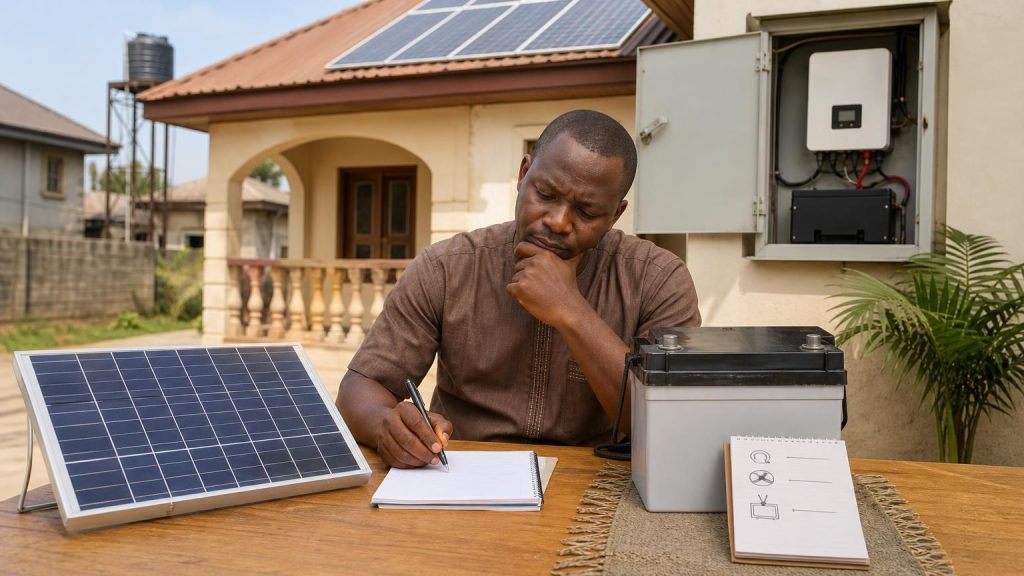
Imagine a Nigerian home with these observations:
- The existing battery reaches full charge by about 2 p.m. on a normal sunny day.
- It reaches its minimum setting around 2 a.m.
- The family wants backup until 6 a.m.
- Non-essential evening loads account for an estimated 1.2kWh.
In this situation, adding panels first may not help because the battery is already full while sunlight remains. The first low-cost test is to remove or reschedule some of the 1.2kWh load. If that gives enough extra hours, no equipment purchase may be needed. If the family still needs the full load, a compatible increase in battery storage is more likely to solve the night-time shortage.
Now change the observation: the battery is only 55% charged at sunset and never reaches full charge, even though the home needs the same night-time backup. In that version, a bigger battery is not the first purchase. Check for a fault, reduce daytime consumption and assess whether more solar panels are needed to provide the missing daily energy.
A simple decision rule
| What you observe | Most sensible first step | Why |
|---|---|---|
| Battery is low at sunset | Test charging, reduce daytime load or add compatible panels | The system is short of daily energy or has a charging problem |
| Battery is full early but empty at night | Reduce night load or add compatible battery storage | The constraint is stored energy, not necessarily solar collection |
| Panels produce much less than expected | Clean, inspect and test before buying equipment | A fault, shade or poor connection can make an upgrade unnecessary |
| Inverter trips when a motor or heater starts | Check running and surge load, battery current and inverter limits | More kWh does not automatically fix an output-power problem |
| Battery indicator is unreliable | Test voltage, current, state of charge and battery health | A bad reading can send you toward the wrong upgrade |
Do not compare the options by purchase price alone
A fair comparison includes the equipment, installation and any parts needed to make the upgrade safe and compatible.
- More panels: panels, mounting, solar cable, connectors, isolators, protection and possible controller or inverter changes.
- More battery: the battery or batteries, compatible configuration, BMS or communication requirements, busbars, cables, fuses, breakers, ventilation or mounting requirements and commissioning.
- Load reduction: possibly no equipment cost, but it may require a critical-load circuit, appliance scheduling, efficient replacement appliances or a change in household routine.
- Repair first: inspection, testing, cleaning, replacement of a failed protection device or correction of settings may cost less than an incorrectly sized upgrade.
When comparing quotations, ask for exact models, quantities, ratings, protection, labour and exclusions. A low price can simply leave out the parts required for a safe working installation. See how to check whether a solar quote is overpriced or missing important parts.
What to check before approving a battery or panel upgrade
- Write down the appliances that must run and the hours required.
- Separate continuous running power from starting or surge power.
- Record actual PV production and battery behaviour on normal days.
- Calculate the energy gap instead of relying on an inverter label such as 5kVA.
- Check the exact inverter, battery and controller manuals.
- Confirm voltage, current, charging, discharge, PV and protection limits.
- Request an itemised quotation that includes installation and safety equipment.
- Have a competent solar installer or electrician test the system before changing high-current wiring or battery connections.
For a first estimate of battery energy, you can use the SolarPriceNG Battery Calculator. Treat the result as a planning aid, then verify it against the exact battery datasheet, inverter limits and your real appliance schedule.
The bottom line
Reduce your load first when non-essential appliances are using the energy you are trying to preserve. This is often the cheapest test and may solve a short evening shortage without new equipment.
Add more solar panels when the battery is not receiving enough energy during the day, provided that the panels, controller, inverter, wiring and protection can be expanded safely.
Add a bigger battery when the existing battery regularly fills before evening but does not hold enough usable energy for the night-time load.
Repair or test first when the system is not producing, charging or reporting normally. A fault can make a healthy system look undersized.
The cheapest safe option is the one that closes the real energy gap without creating a new problem. Measure first, compare the required energy with the available solar and storage, and do not change battery-bank or high-current wiring without a properly designed and tested installation.
Technical references
- U.S. Department of Energy: Solar Integration and Storage Basics — explains the difference between storage energy capacity and power capacity, and why storage and solar solve different timing problems.
- Victron Energy: ESS Design and Installation Manual — provides practical guidance on battery sizing, autonomy and checking system limits.
- NREL: Simplified Method for Modelling the Impact of Partial Shading — shows why shading losses depend on the actual system rather than a single universal percentage.