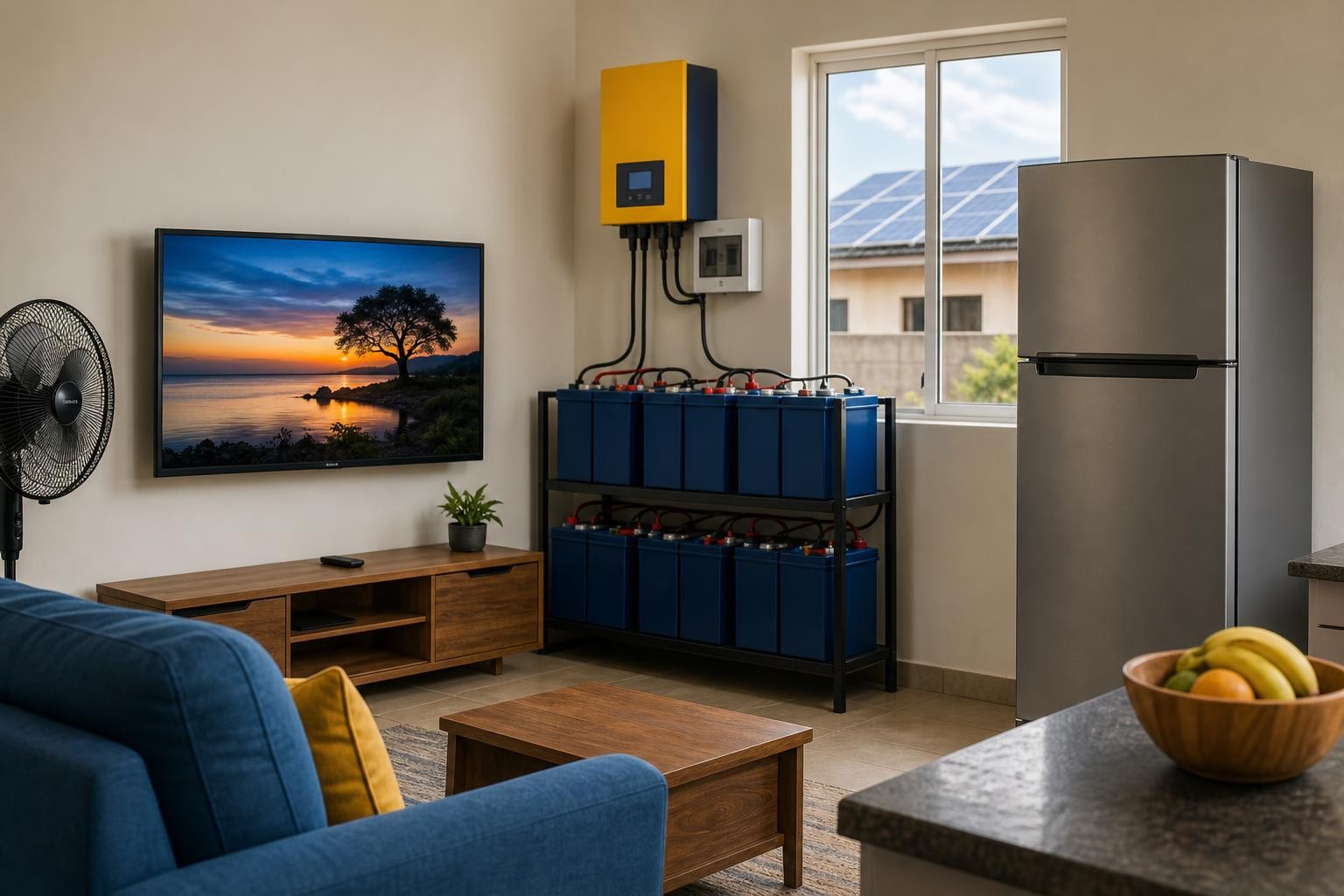
Short answer: There is no fixed rule that says a fridge and TV need one, two or four 48V battery banks. The correct number depends on the battery bank’s usable energy, the fridge’s real average consumption, the TV and other loads, the backup time you want, and the inverter’s limits.
For a practical first estimate, calculate the energy required in a day or during the outage, then divide it by the usable energy from one battery bank. A 48V system is commonly built around a nominal voltage of about 48V or 51.2V, but the battery’s actual voltage, Ah rating, chemistry and manufacturer limits still matter.
For example, one 51.2V 100Ah lithium module has about 5.12kWh of nominal energy in the manufacturer data used for this illustration. If you plan around 80% usable battery energy and 90% inverter efficiency, the estimated AC energy available from one module is about 3.69kWh. At a carefully measured average fridge-and-TV load of 180W, that is roughly 20 hours on paper. If the actual average load is 250W, the same bank gives roughly 15 hours. Real results can be shorter because of compressor starts, other appliances, battery limits, temperature and inverter standby consumption.
What “one 48V battery bank” can mean
People use the phrase 48V battery bank in different ways. Before counting banks, identify exactly what the installer or seller is describing.
- One 51.2V lithium module: often sold as a 48V-class battery for a 48V inverter.
- Four 12V batteries in series: the voltages add to make a 48V-class bank, while the Ah rating stays the same as one battery in the series string.
- Two 24V battery units in series: another way to build a 48V-class bank, if the batteries and manufacturer allow it.
- Parallel 48V banks: each bank remains at roughly the same system voltage, while the available energy and current capability increase.
So “one bank” does not automatically mean one physical battery. It may be a matched series string or one factory-built lithium module. Ask for the battery voltage, Ah or kWh, chemistry, quantity, connection method and usable-energy assumption.
This is also why you should not compare a lithium battery and a lead-acid battery by Ah alone. A 48V 100Ah lithium battery and a 48V 100Ah lead-acid bank have the same simple nominal voltage-and-Ah calculation, but their permitted depth of discharge, voltage behaviour, charging limits and practical usable energy may be different.
The calculation: how many banks do you need?
Use this sequence:
- List the appliances that must run during the outage.
- Estimate their average running load in watts.
- Estimate how many hours they need to run.
- Calculate the required AC energy: watts × hours ÷ 1,000.
- Calculate the usable AC energy from one battery bank.
- Divide the required energy by the usable energy per bank.
- Round up and then check inverter output, surge, battery discharge current and installation limits.
A simple planning formula is:
Number of banks = required AC energy ÷ (nominal battery energy × usable fraction × inverter efficiency)
That formula is an estimate, not a promise. Use the actual battery data sheet and inverter manual for the final design.
Example: one fridge and one TV

Assume the following for a planning example:
- one 51.2V 100Ah lithium battery module;
- nominal energy: 51.2V × 100Ah = 5,120Wh, or 5.12kWh;
- usable fraction used for planning: 80%;
- inverter efficiency used for planning: 90%;
- fridge and TV average load: 180W; and
- required backup time: 24 hours.
The estimated AC energy from one bank is:
5.12kWh × 0.80 × 0.90 = 3.69kWh
The estimated energy needed for the appliances is:
0.18kW × 24 hours = 4.32kWh
The theoretical bank count is:
4.32 ÷ 3.69 = 1.17 banks
Because you cannot install 1.17 battery banks, the planning answer is two banks for this set of assumptions. One bank may be enough for a shorter outage or a lower measured average load, but it does not provide the same margin for a full day.
Now change the average load to 250W:
0.25kW × 24 hours = 6kWh
6 ÷ 3.69 = 1.63 banks
The rounded-up answer is still two banks, but the available reserve is smaller. If the fridge is old, the room is hot, the door opens often, or you also run a decoder, router, fans or lights, the load may be higher again.
Why the fridge makes sizing less straightforward
A television usually has a fairly stable running demand while it is on. A refrigerator is different because its compressor cycles on and off. It may use modest energy over an hour but still need a short starting surge when the compressor starts.
Battery sizing therefore has two separate checks:
- Energy check: can the banks supply enough kWh for the total hours?
- Power and surge check: can the inverter and battery deliver the starting current when the compressor starts?
Two banks can solve an energy shortage but will not automatically solve an inverter overload. Conversely, a large inverter can start the fridge but a small battery can still run flat quickly. The inverter’s continuous output, surge rating, battery discharge-current limit and cable protection all need to agree. If you are unsure how compressor starting demand affects the system, see SolarPriceNG’s guide to surge power in a solar inverter.
Quick planning table for a 51.2V 100Ah lithium example
The table below uses the same illustrative assumptions: 5.12kWh nominal per bank, 80% usable energy and 90% inverter efficiency. It is not a universal performance guarantee for every battery sold in Nigeria.
| Number of banks | Nominal energy | Estimated AC energy after assumptions | At 180W average load | At 250W average load |
|---|---|---|---|---|
| 1 | 5.12kWh | 3.69kWh | About 20.5 hours | About 14.7 hours |
| 2 | 10.24kWh | 7.37kWh | About 41 hours | About 29.5 hours |
| 3 | 15.36kWh | 11.06kWh | About 61 hours | About 44 hours |
These are arithmetic estimates. A fridge does not draw its starting power continuously, the inverter consumes some power even when the load is light, and the battery management system may stop discharge before the theoretical energy is fully used. If the battery is lead-acid, high discharge rates can reduce practical capacity further.
What if the battery is a 48V 200Ah lead-acid bank?
A 48V 200Ah bank has a simple nominal-energy calculation of:
48V × 200Ah = 9,600Wh, or 9.6kWh nominal
That does not mean you should plan to use all 9.6kWh. For an illustrative lead-acid planning case, assume 50% usable depth of discharge and 85% inverter efficiency:
9.6kWh × 0.50 × 0.85 = 4.08kWh estimated AC energy
At 180W, that works out to about 22.7 hours before other real-world limits are considered. The result looks similar to the lithium example, but the battery types are not interchangeable. The correct discharge limit, charging voltage, temperature behaviour, battery age and manufacturer guidance should control the final design.
When one bank may be enough
One 48V-class bank may be reasonable when:
- the outage is usually short;
- you only need the fridge and TV for a limited period;
- the fridge is efficient and has been measured rather than guessed;
- the TV is used for only part of the outage;
- you do not add other loads to the backup circuit; and
- the inverter can handle the compressor’s starting demand.
For example, if your measured average load is closer to 150W and you need six to ten hours of backup, one suitable bank may be adequate under the battery maker’s usable-energy limits. The right answer should come from the expected energy and surge demand, not from a rule such as “one 48V bank per fridge.”
When two or more banks may be needed
Consider additional banks when:
- you need overnight or all-day backup;
- the fridge is large, old or used in a very hot room;
- you also run fans, lights, a decoder, router, CCTV or phone charging;
- the battery must keep a reserve for the next outage;
- you want to reduce generator use for longer periods; or
- the inverter’s DC current limit means the system cannot safely draw the desired power from one bank.
Adding banks increases stored energy, but it also adds cost, weight, cabling, fusing, isolation and installation requirements. The batteries should be matched according to the manufacturer’s rules. Do not casually mix different ages, chemistries, capacities or brands in parallel.
Checks before you approve the battery quote

Before paying a deposit, ask the installer or seller to write down:
- the exact battery brand and model;
- nominal voltage and whether the product is 48V or 51.2V nominal;
- capacity in kWh or Ah, with the voltage if Ah is used;
- recommended and maximum continuous discharge current;
- usable depth of discharge or minimum state-of-charge setting;
- the number of physical modules and how they are connected;
- the inverter’s continuous and surge output;
- the expected fridge starting demand; and
- the estimated runtime, including the loads and assumptions used.
If the quote simply says “two 48V batteries” without model, capacity, chemistry and usable-energy details, it is not enough information to verify the design. SolarPriceNG’s guide on checking the battery capacity on a solar quote explains the same verification problem in more detail.
Do not forget the inverter and wiring
A fridge and TV may have a modest average wattage, but the inverter must still be able to start the compressor. Check the inverter’s continuous watt rating, surge duration, low-voltage cut-off and battery-voltage requirement. Check the battery manufacturer’s maximum discharge current and the DC cable, fuse and isolator ratings as well.
If you are unsure whether your system should be 24V or 48V, read SolarPriceNG’s 24V versus 48V solar system comparison. A higher-voltage battery system can reduce DC current for the same power, but it still requires compatible equipment and safe installation.
For a runtime-focused calculation, see how long a 48V battery bank may last for a fridge and TV. That question starts with the number of banks you already have; this guide starts with the number you may need.
If your backup ends earlier than expected even though the inverter appears to show a healthy battery, read how to tell whether the battery or inverter is causing the problem before buying more equipment.
Final answer
For a fridge and TV in Nigeria, one 48V-class battery bank may be enough for a short outage, while two or more may be needed for overnight or all-day backup. The answer cannot be determined from the inverter size or the phrase “48V battery” alone.
Calculate the fridge-and-TV energy requirement, convert the battery’s nominal voltage and capacity into usable AC energy, round up the bank count, and then verify compressor surge, battery discharge current, inverter limits and safe installation. If the battery is lithium, use kWh as the main capacity measure. If it is tubular, GEL or AGM, use Ah together with voltage and the manufacturer’s usable-energy guidance.
Manufacturer reference for the calculation
As one manufacturer example, Victron Energy’s official technical data lists a 51.2V 100Ah lithium battery with 5,120Wh nominal energy and publishes separate information about usable depth of discharge and system limits. That is an example of how to read a battery data sheet, not a claim that every 48V-class battery has the same capacity or performance. Always use the data sheet for the exact battery in your quotation.