
If you are planning a 5kVA solar inverter, you may also be wondering:
How many solar panels do I need for a 5kVA inverter?
There is no single number that works for every 5kVA system.
A 5kVA inverter does not automatically need 8 panels, 10 panels or 12 panels.
The number of solar panels depends on:
- Your total daily electricity use
- Battery size
- How much energy you want to replace each day
- Solar panel wattage
- Useful sunlight hours
- Solar system losses
- Inverter and charge controller specifications
- The manufacturer’s maximum solar input
For example, a system using 500W panels will need a different number of panels from one using 550W or 600W panels.
This guide explains how to estimate the right number of solar panels for a 5kVA inverter in Nigeria and what you should check before buying the panels.
Quick Answer: How Many Solar Panels Do I Need for a 5kVA Inverter?
There is no fixed number.
A 5kVA inverter can be paired with different solar array sizes depending on the inverter model and the energy needs of the system.
For example, a solar array could contain:
- 6 × 500W panels = 3,000W
- 8 × 500W panels = 4,000W
- 10 × 500W panels = 5,000W
- 12 × 500W panels = 6,000W
But you cannot choose the number based only on the 5kVA inverter rating.
You must check the inverter’s:
- Maximum PV input power
- Maximum PV voltage
- Maximum PV current
- MPPT operating range
- Maximum number of MPPT inputs
- Recommended solar array size
You also need to calculate how much solar energy your home actually needs.
Does a 5kVA Inverter Need 5,000W of Solar Panels?
Not necessarily.
This is one of the most common mistakes when planning solar.
People see:
5kVA inverter
and assume:
5,000W solar panels
But the inverter’s kVA rating and the solar array’s wattage are measuring different things.
The inverter tells you about the amount of electrical power it can supply.
The solar panels determine how much solar power can be generated and how much energy can be collected during the day.
You can therefore have a:
5kVA inverter + 3kW solar array
or:
5kVA inverter + 5kW solar array
or:
5kVA inverter + 6kW solar array
if the inverter allows the selected PV configuration and the system is properly designed.
If you are still deciding whether you need a 5kVA inverter in the first place, start with the SolarPriceNG Inverter Calculator.
How Do I Calculate Solar Panels for a 5kVA Inverter?
The basic calculation starts with your daily energy requirement.
A simple formula is:
Solar panel size = Daily energy needed ÷ Useful sunlight hours
For example, suppose your home needs:
12kWh per day
and you plan around:
4.5 useful sunlight hours
The simple calculation is:
12kWh ÷ 4.5 = 2.67kW
So you would need roughly:
2.67kW of solar panels
before accounting for system losses.
In a real installation, you need to allow for losses caused by:
- Heat
- Dust
- Panel mismatch
- Wiring
- Controller/inverter losses
- Shading
- Installation conditions
- Panel ageing
This means the actual solar array may need to be larger.
How Many 500W Solar Panels Do I Need?
500W panels are popular for larger solar systems.
One 500W panel provides:
500W
So:
| Number of Panels | Solar Array |
|---|---|
| 4 | 2,000W |
| 6 | 3,000W |
| 8 | 4,000W |
| 10 | 5,000W |
| 12 | 6,000W |
| 14 | 7,000W |
For example:
10 × 500W = 5,000W
or:
5kW
But this does not mean every 5kVA inverter should be connected to 10 × 500W panels.
The inverter’s maximum PV input must be checked first.
How Many 550W Panels Do I Need?
The calculation is similar.
One 550W panel provides:
550W
Therefore:
| Number of Panels | Solar Array |
|---|---|
| 4 | 2.2kW |
| 6 | 3.3kW |
| 8 | 4.4kW |
| 10 | 5.5kW |
| 12 | 6.6kW |
| 14 | 7.7kW |
So:
10 × 550W = 5.5kW
Again, the inverter manufacturer’s PV limits determine whether the selected array is acceptable.
You can see the different panel wattages currently listed in the SolarPriceNG Solar Panels price database.
How Many 600W Solar Panels Do I Need for a 5kVA Inverter?
The number of 600W panels you need depends on the solar capacity you want and the maximum PV input allowed by your inverter.
For example:
| 600W panels | Total solar capacity |
|---|---|
| 4 | 2.4kW |
| 6 | 3.6kW |
| 8 | 4.8kW |
| 9 | 5.4kW |
| 10 | 6kW |
| 12 | 7.2kW |
For example, 8 × 600W panels = 4,800W (4.8kW), while 10 × 600W panels = 6,000W (6kW).
However, this does not mean every 5kVA inverter can safely use 8, 10 or 12 of these panels.
Before deciding how many panels to connect, check the inverter’s:
- Maximum PV input power
- Maximum PV voltage
- Maximum PV current
- MPPT operating range
- Number of MPPT inputs
The panel voltage and current also matter because the way the panels are connected in series or parallel affects the final PV voltage and current.
So the correct number of 600W panels is the number that provides the solar capacity your system needs while staying within the inverter’s PV specifications.
How Many Panels Do I Need to Produce 10kWh Per Day?
Let’s use a simple example.
Suppose you want approximately:
10kWh of solar energy per day
and you have:
4.5 useful sunlight hours
A basic calculation is:
10 ÷ 4.5 = 2.22kW
You would therefore start around a:
2.2kW solar array
before accounting for losses.
If using 500W panels:
2.22kW ÷ 0.5kW = 4.44 panels
You cannot install 4.44 panels, so you would normally move up to:
5 × 500W = 2.5kW
But because real systems do not produce their nameplate output throughout the entire sunlight period, additional capacity may be needed.
This is why simply dividing energy by sunlight hours is only the starting point.
How Many Panels Do I Need to Recharge a 10kWh Battery?
This depends on how much energy you actually need to put back into the battery.
Suppose your battery needs:
10kWh
of energy replaced.
At a simple planning level, if your system receives:
4.5 useful sunlight hours
then:
10 ÷ 4.5 = 2.22kW
of theoretical panel capacity.
In practice, the solar array needs to be larger because the full rated panel output is not maintained throughout the day and there are system losses.
Your battery type also matters because the amount of energy that needs to be replaced depends on how much energy was actually used.
For battery sizing, you can use the SolarPriceNG Battery Calculator.
A 5kVA Inverter Can Have Different Solar Panel Sizes
This is important.
Imagine two homes both use a 5kVA inverter.
Home A
Average daily energy requirement:
6kWh
Battery:
5kWh
Home B
Average daily energy requirement:
15kWh
Battery:
15kWh
The two homes may use the same inverter size, but Home B needs much more solar generation.
Why?
Because the solar array is not chosen from the inverter kVA alone.
It is chosen from the energy the system needs to produce and the inverter’s allowable PV input.

What Size Solar Array Is Good for a 5kVA Inverter?
There is no universal answer.
As a simple illustration, you may see systems using solar arrays around:
- 3kW
- 4kW
- 5kW
- 6kW
- 7kW or more
But the correct array depends on the exact inverter.
Some inverters allow a PV array larger than their AC output rating.
For example, an inverter may have a 5kVA AC output rating but allow a larger DC solar array.
This is why you should never assume:
5kVA inverter = maximum 5kW solar
Check the manufacturer’s PV specifications.
Why Can a 5kVA Inverter Have More Than 5kW of Solar Panels?
Solar panels rarely produce their full rated output continuously.
A panel labelled:
500W
does not mean it will produce exactly 500W every moment of the day.
Output changes because of:
- Sun intensity
- Heat
- Dust
- Clouds
- Panel orientation
- Shading
- Wiring losses
- Panel condition
Because of this, some solar inverter systems are designed with a DC solar array larger than the inverter’s AC output rating.
However, the manufacturer’s permitted PV input must always be followed.
Do not oversize the array simply because you saw someone else using a larger solar array.
Check the Inverter’s Maximum PV Input
Before buying your panels, find these specifications on the inverter datasheet:
Maximum PV power
This tells you the maximum solar array power the inverter is designed to accept.
Maximum PV voltage
This is extremely important when panels are connected in series.
Maximum PV current
This matters when designing parallel strings.
MPPT voltage range
The panel string needs to operate within the inverter’s MPPT voltage range.
Number of MPPTs
Some inverters have more than one MPPT input.
This can allow different panel strings to be managed separately.
Always follow the exact manufacturer’s specifications.
Series and Parallel Panel Connections
The number of panels is only part of the design.
You also need to decide how the panels are connected.
Series connection
Connecting panels in series increases voltage.
For example:
2 × 500W panels in series
still gives:
1,000W
but the voltage increases while the current remains approximately that of one panel.
Parallel connection
Connecting strings in parallel increases current while the voltage remains approximately that of one string.
The exact design depends on the panel’s:
- Voc
- Vmp
- Isc
- Imp
and the inverter’s:
- Maximum PV voltage
- Maximum PV current
- MPPT voltage range
This is why you should not design a solar array by simply counting panels.
How Many Panels Can a 5kVA Inverter Handle?
There is no standard answer.
A 5kVA inverter from one manufacturer may have different PV limits from another.
For example, one model may accept:
5kW PV
while another may accept:
6kW, 7kW or more
The exact specification matters.
The same applies to the number of panels.
Eight 500W panels and ten 400W panels both produce different total array sizes even though the panel counts are different.
Always check the inverter datasheet before connecting the array.
What Happens If I Use Too Many Solar Panels?
Connecting too many panels can create a serious technical problem if the array exceeds the inverter’s permitted PV voltage, current or power.
Possible problems include:
- Exceeding the inverter’s PV voltage limit
- Exceeding the PV current limit
- Poor system operation
- Inverter faults
- Equipment damage
Never assume that because the inverter is 5kVA, any number of panels can be connected.
The inverter manufacturer’s limits are the final authority.
What Happens If I Use Too Few Solar Panels?
Too few panels may still allow the system to operate, but you may have problems such as:
- Slow battery charging
- Insufficient daytime generation
- Battery failing to recharge fully
- Heavy reliance on grid or generator
- Poor performance during cloudy periods
This is especially important if you have a large battery.
A large battery needs enough solar generation to recharge it within your available sunlight hours.
5kVA Inverter + 5kWh Battery: How Many Panels?
Let’s consider a simple example.
Suppose you have:
5kVA inverter
and:
5kWh battery
If you regularly use most of the battery overnight, the solar array must produce enough energy during the day to replace the energy used.
The exact panel requirement depends on:
- How much energy you use
- How much battery energy you replace
- Daytime loads
- Useful sunlight hours
- System losses
- Inverter PV limits
For example, a 3kW or 4kW array may be suitable for some systems, while another home may need more.
There is no correct answer based only on “5kVA + 5kWh.”
How Many Solar Panels Do I Need for a 5kVA Inverter With a 10kWh Battery?
A 5kVA inverter with a 10kWh battery does not have one fixed solar panel requirement.
The panels need to produce enough energy to cover your daily use and replace the battery energy you use.
For example, if you regularly need to replace about 8kWh of battery energy each day, the solar array needs to generate enough energy to replace that amount while also covering any daytime loads and system losses.
The number of panels therefore depends on:
- How much energy you use each day
- How much battery energy you normally use
- Useful sunlight hours
- Solar system losses
- Panel wattage
- The inverter’s maximum PV input
For example, 8 × 600W panels provide 4.8kW of nominal solar capacity, while 10 × 500W panels provide 5kW.
Neither configuration should be chosen from the battery size alone. Check the inverter’s PV specifications and calculate the actual energy requirement first.
5kVA Inverter + 10kWh Battery: How Many Panels?
A 10kWh battery can store roughly twice the nominal energy of a 5kWh battery.
If you regularly use a large part of that storage, you will normally need more solar generation to recharge it.
For example, if you need to replace approximately:
8kWh
of battery energy each day, your solar array must be sized to generate enough energy to replace that amount while also covering any daytime loads.
This is why the SolarPriceNG Solar Panel Calculator includes battery recharge requirements rather than simply asking for your inverter size.
5kVA Inverter + 15kWh Battery: How Many Panels?
The same principle applies.
A 15kWh battery provides more storage than a 5kWh or 10kWh battery.
If you regularly use a large amount of that stored energy, you need enough solar generation to recharge it.
The system may therefore require a larger solar array.
But again, do not select the array simply because the battery says 15kWh.
The inverter’s PV input limits still have to be respected.
Nigerian Sunlight and Solar Panel Sizing
Nigeria receives good solar resources in many parts of the country, but the amount of useful sunlight available to your panels varies by:
- Location
- Season
- Weather
- Cloud cover
- Panel orientation
- Shading
- Installation quality
This means you should not assume that a panel rated 500W will produce 500W × 12 hours every day.
Solar systems should be planned using useful sunlight hours, not the total number of daylight hours.
For initial planning, your actual location and system conditions should be considered.
Should I Buy More Panels Because of Cloudy Weather?
Adding reasonable extra solar capacity can help compensate for real-world losses and periods of weaker sunlight, but you cannot simply keep adding panels without checking the inverter’s limits.
The correct approach is:
Calculate energy requirement → estimate solar resource → account for losses → check inverter limits → design the array.
If more solar generation is required than one inverter can safely accept, the solution may involve a different system design rather than simply connecting more panels.
How Many Panels Do I Need for a 5kVA Inverter With Air Conditioning?
Air conditioners can significantly increase electricity consumption.
A 1HP inverter air conditioner may consume much less than its maximum rated power at some times, but actual consumption depends on:
- Model
- Temperature setting
- Room size
- Insulation
- Outdoor temperature
- Compressor operation
- Usage pattern
If you want to run an air conditioner regularly from your solar system, you should calculate the actual energy requirement rather than using the inverter’s 5kVA rating.
Start by checking the appliance’s actual power consumption and operating hours.
Then use the SolarPriceNG Solar Calculator or Solar Panel Calculator to plan the system.
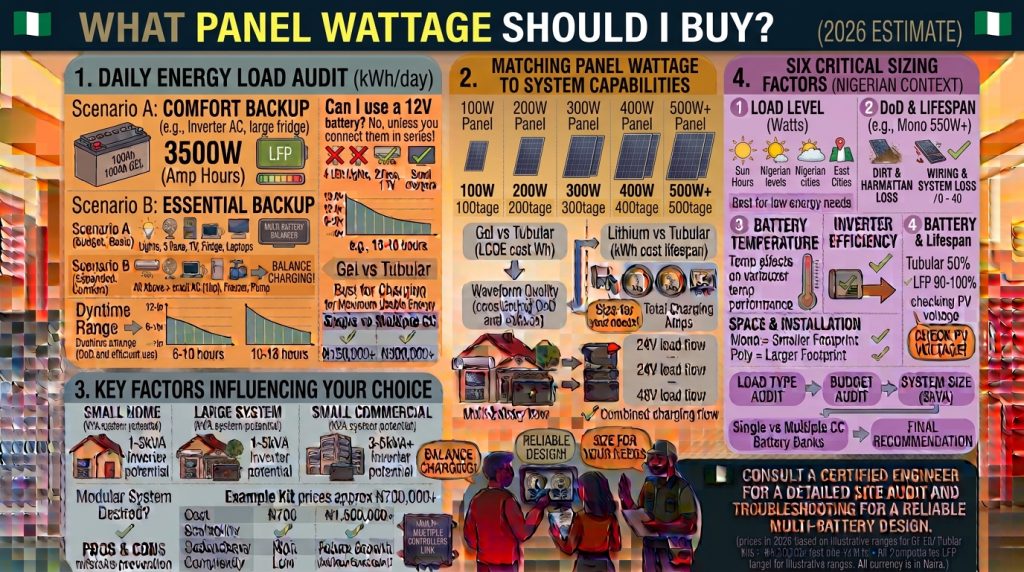
What Panel Wattage Should I Buy?
There is no single best panel wattage.
SolarPriceNG currently tracks different panel sizes in the Nigerian market, including smaller and larger wattages.
Common options include:
- 250W
- 300W
- 400W
- 450W
- 500W
- 550W
- 600W
- 650W
Higher-wattage panels can reduce the number of panels needed for a given array size.
For example:
10 × 400W = 4kW
while:
8 × 500W = 4kW
Both arrays have the same nominal power.
The physical panel size, voltage/current characteristics and inverter limits should also be considered.
Is 10 × 500W Better Than 8 × 600W?
Both arrays have similar total rated power:
10 × 500W = 5,000W
8 × 600W = 4,800W
So the 10-panel system has slightly more nominal capacity.
But that does not automatically make it better.
You should compare:
- Panel efficiency
- Voc
- Vmp
- Isc
- Imp
- Physical size
- Warranty
- Brand
- Price
- Inverter compatibility
- Available roof space
The cheapest panel per watt is not always the best choice.
How Much Roof Space Do I Need?
Panel size matters.
Larger wattage panels can produce more power per panel, but they may also be physically larger.
For example, an array of:
10 panels
may require more roof space than:
8 panels
depending on the physical dimensions of the panels.
Before buying, measure the available roof area and consider:
- Shading
- Panel spacing
- Roof direction
- Roof angle
- Maintenance access
- Mounting structure
Do not plan the system using wattage alone.
Use the SolarPriceNG Solar Panel Calculator
The easiest way to estimate your solar array is to use the SolarPriceNG Solar Panel Calculator.
You can consider:
- Battery/system voltage
- Panel type
- Panel wattage
- Useful sunlight hours
- System performance/loss factor
- Daytime appliance use
- Battery energy that needs to be replaced
This gives you a more useful starting point than simply saying:
“I have a 5kVA inverter, so I need X panels.”
What About the Charge Controller?
If your system uses a separate charge controller, the controller must also be suitable for the solar array.
You need to check:
- Controller type
- Battery voltage
- PV voltage
- PV current
- Maximum PV power
- Panel configuration
The SolarPriceNG Charge Controller Calculator can help you estimate the controller requirement.
However, the manufacturer’s maximum voltage, current and power specifications should always take priority.
Don’t Forget Battery Charging
A solar system is not just:
Panels → Inverter → Appliances
If you are using solar panels to charge batteries, the system must also provide enough solar energy to replace what you use.
For example:
Night battery use = 8kWh
You need enough solar generation during the day to replace that energy, while also supplying any daytime loads.
This is why battery size and panel size should be planned together.
Our 5kVA inverter battery guide explains how battery capacity should be selected for a 5kVA system.
Common Mistakes to Avoid
Assuming 5kVA means 5kW of panels
The inverter rating does not automatically determine the solar array size.
Choosing panels by wattage only
Check voltage, current, efficiency, dimensions and manufacturer specifications.
Ignoring the inverter’s maximum PV voltage
This can be dangerous and can damage equipment.
Ignoring PV current
The panel configuration must stay within the inverter’s allowed PV current.
Forgetting battery recharge
A large battery requires enough solar generation to recharge it.
Using total daylight hours
Solar planning should use useful sunlight hours rather than assuming full panel output throughout daylight.
Adding too many panels without checking the inverter
A larger array is not always better if it exceeds the inverter’s PV limits.
Copying another person’s solar setup
A friend’s 5kVA system may have a different load, battery size, panel wattage and inverter model.
Your system should be designed around your own needs.
Example: A Simple 5kVA Solar System
Suppose a home has:
5kVA inverter
10kWh battery
and average daily energy use of:
10kWh
Suppose the initial solar planning uses:
4.5 useful sunlight hours
The basic array calculation is:
10 ÷ 4.5 = 2.22kW
After allowing for real-world system losses, you may choose a larger array.
For example:
6 × 500W = 3kW
could be a starting configuration.
But whether six panels are actually suitable depends on the inverter’s PV input limits and the required energy production.
If the home has higher daily consumption or needs to recharge a heavily discharged battery quickly, a larger array may be needed.
This is why the final design should be based on the actual system specifications rather than a fixed “5kVA = X panels” rule.
Final Answer: How Many Solar Panels Do I Need for a 5kVA Inverter?
A 5kVA inverter does not have one fixed solar panel requirement.
The correct number depends on:
Daily energy use + battery requirement + useful sunlight hours + system losses + inverter PV limits.
For example:
10 × 500W = 5kW
8 × 600W = 4.8kW
12 × 550W = 6.6kW
All of these are different solar arrays that could potentially be used in different system designs.
But the inverter’s manufacturer’s specifications determine which array is actually compatible.
Before buying panels, check:
- Maximum PV power
- Maximum PV voltage
- Maximum PV current
- MPPT voltage range
- Number of MPPT inputs
- Recommended solar array size
Then calculate how much energy your home needs and how much battery energy you need to replace.
The best approach is not:
“I have a 5kVA inverter, so how many panels should I buy?”
Instead ask:
“How much energy does my home need, how much battery energy must I replace, and what solar array can my inverter safely accept?”
That gives you a much more accurate solar system.
Frequently Asked Questions
Can I use 10 × 500W panels with a 5kVA inverter?
Possibly.
That gives a nominal solar array of:
5kW
But you must check whether your exact inverter accepts 5kW of PV power and whether the voltage and current of the panel configuration fall within its limits.
Can a 5kVA inverter use 6kW of solar panels?
Some models may allow a solar array larger than their AC output rating.
However, this is model-specific.
Check the inverter manufacturer’s maximum PV power, voltage and current before connecting the panels.
How many 500W panels do I need for 5kW?
You need:
5,000W ÷ 500W = 10 panels
So:
10 × 500W = 5kW
How many 600W panels make 5kW?
The exact number cannot produce exactly 5kW using whole 600W panels.
Eight panels give:
8 × 600W = 4.8kW
Nine panels give:
9 × 600W = 5.4kW
Whether 8 or 9 is appropriate depends on the energy requirement and inverter specifications.
Is 5kW of solar enough for a 5kVA inverter?
It may be suitable for some systems, but there is no guarantee.
Solar array size should be based on energy needs and inverter specifications.
How many panels do I need to charge a 10kWh battery?
It depends on how much of the battery you use, useful sunlight hours, system losses and the inverter/charger limits.
A 10kWh battery does not automatically require a fixed number of panels.
Can I use 250W panels with a 5kVA inverter?
Potentially, yes, if the panel voltage/current and the total array configuration are compatible with the inverter.
You would simply need more panels to reach the same total wattage.
For example:
20 × 250W = 5kW
Should I use 500W or 600W panels?
Compare the complete specifications rather than wattage alone.
Consider price per watt, efficiency, voltage, current, physical size, warranty, roof space and inverter compatibility.
How many 600W solar panels do I need for a 5kVA inverter?
There is no fixed number. For example, 8 × 600W panels provide 4.8kW, while 10 × 600W panels provide 6kW. The correct number depends on your energy needs and the inverter’s maximum PV power, voltage and current limits.
How many solar panels do I need for a 5kVA inverter with a battery?
The battery size alone does not determine the number of panels. You need to consider how much energy you use, how much battery energy must be replaced, useful sunlight hours, system losses and the inverter’s PV limits.
Related SolarPriceNG Guides
You may also find these guides useful:
- How Many Batteries Do I Need for a 5kVA Inverter in Nigeria?
- How Many Solar Panels Do I Need for My House in Nigeria?
- How Many Batteries Do I Need for a Solar System in Nigeria?
- 24V vs 48V Solar System: Which Should You Choose?
- How Much Is a Solar Panel in Nigeria? 2026 Prices by Wattage
- Inverter Battery Price in Nigeria: Lithium vs Tubular vs GEL