If your solar inverter shuts down at night, the first question is whether it is supposed to run after sunset. A grid-tied inverter without a battery normally stops when there is no sunlight. A hybrid or off-grid inverter, however, should usually supply your loads from the battery, so a night-time shutdown may point to low battery voltage, excessive load, a battery or cable problem, or an incorrect operating setting.
Do not immediately assume that the solar panels are faulty. At night the panels are no longer charging the battery, so weaknesses in the battery, wiring, system sizing or settings often become more obvious.
First: identify the type of inverter
Grid-tied inverter
A grid-tied inverter is designed to work with the public electricity supply. Many models do not have a battery and cannot provide power during a blackout or after sunset. They shut down when there is no solar generation or when the grid is unavailable. This can be normal behaviour, not a fault.
Hybrid or off-grid inverter
A hybrid or off-grid inverter can normally use stored battery energy when solar production falls. If this type of inverter shuts down every night, especially before morning, investigate the battery level, loads, connections, protection devices and settings. If you are comparing system types, see our guide to hybrid and off-grid inverters for a Nigerian home.
Check the label, display menu or manual for terms such as hybrid, off-grid, backup, battery priority or grid-tie. If you are not sure which type you have, ask the installer before changing settings.
Common causes of a solar inverter shutting down at night
1. The battery reaches its low-voltage cut-off
This is one of the most common causes. During the day, solar power may keep the system running even when the battery is weak or undercharged. After sunset, the battery carries the load alone. Its voltage then falls until the inverter disconnects to protect the battery.
This is more likely when:
- the inverter shuts down at roughly the same time each night;
- the display shows low battery, battery under-voltage or a similar warning;
- the system restarts after the sun comes up and charging begins;
- the battery is old, damaged, poorly charged or too small for the night-time load.
Do not judge the battery only by its voltage immediately after charging. A battery can show a reasonable voltage with little usable energy remaining. The battery’s chemistry, age, temperature, discharge rate and inverter efficiency also affect how long it can run. If the battery seems to empty much faster than before, read our guide on why a solar battery may be draining quickly.
2. The night-time load is higher than expected
Many households use more power in the evening. Lights, televisions, fans, refrigerators, freezers, internet equipment, water pumps, pressing irons and other appliances may run at the same time. In some homes, the system is sized for daytime use but not for the full evening routine.
A load can also have a high starting demand. Refrigerators, freezers, pumps and some air conditioners may briefly draw much more power when their motors start. The inverter may shut down because of overload or surge even if the normal running wattage looks acceptable. Learn more about this in our explanation of inverter surge power.
As a simple energy check, a 500-watt load running for 6 hours needs about:
500 W × 6 hours = 3,000 Wh, or 3 kWh
That is before allowing for inverter losses, battery limits and other loads. If several appliances are used through the night, the required battery capacity can be much higher than expected.
3. The battery is ageing or has a failed section
Lead-acid batteries can lose capacity as they age, are deeply discharged, remain undercharged or operate in excessive heat. A battery bank can also develop an individual weak or failed battery. The system may appear normal during the day but collapse quickly at night when a load is applied.
Lithium batteries may show a similar symptom for a different reason. The battery management system, or BMS, can disconnect the battery because of low cell voltage, excessive current, temperature or another protection event. The inverter may then report a battery communication or battery protection fault.
4. Loose, undersized or damaged battery cables
A poor connection can create a voltage drop between the battery and inverter. When the load increases, the inverter sees a voltage lower than the battery’s actual resting voltage and may shut down.
Possible signs include:
- shutdown when a large appliance starts;
- warm, discoloured or melted cable terminals;
- flickering lights or repeated inverter restarts;
- corrosion around lead-acid battery terminals;
- different voltage readings at the battery and inverter.
High-current battery wiring is dangerous. Do not tighten, replace or bypass cables while the system is energised unless you are qualified and following the manufacturer’s safe isolation procedure.
5. The inverter is set to the wrong operating mode
Hybrid inverters often have settings that control which source supplies the load and when the battery may discharge. Depending on the model, relevant options may include solar priority, utility or grid priority, battery priority, low-battery shutdown voltage, restart voltage, battery type and minimum state of charge.
An incorrect battery type or low-battery setting can cause early shutdown. A minimum battery reserve may also be configured intentionally, meaning the inverter stops supplying loads before the battery is completely empty.
Record the existing settings before changing anything. Use the inverter manual or ask the installer rather than copying a setting from a different model.
6. Over-temperature or poor ventilation
An inverter may reduce output or shut down when its internal temperature becomes too high. The problem can appear at night if the inverter is installed in a hot, enclosed area, covered with dust or surrounded by equipment that restricts airflow.
Check whether the inverter is mounted in a dry, ventilated location and whether its cooling openings or fan are blocked. Do not spray water into the inverter or open the casing.
7. A protection device or input connection is tripping
A DC breaker, battery isolator, fuse or AC protection device may be loose, overloaded or faulty. If the battery connection opens, the inverter can switch off immediately. Some systems also disconnect a load through an external changeover switch or distribution board.
Look for a tripped device or an error message, but do not repeatedly reset a breaker that trips again. Repeated tripping needs investigation because it may indicate a short circuit, overload, wiring fault or failing component.
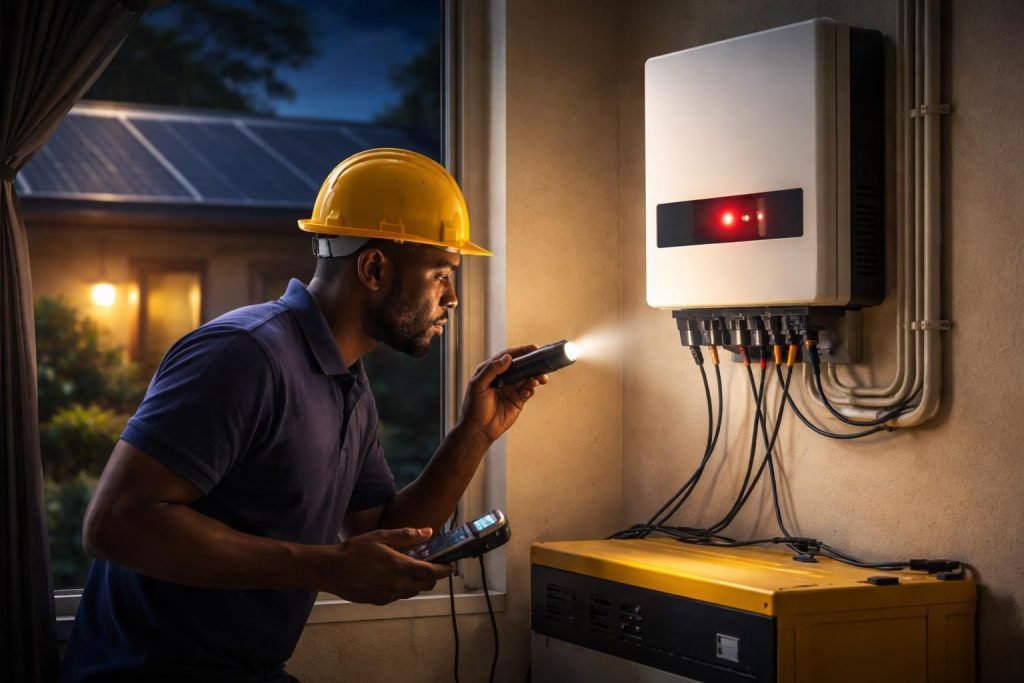
What to check, step by step
1. Note exactly when and how it shuts down
Write down the time, the appliances running, the battery reading, the inverter warning code and whether the system restarts by itself. A shutdown at the same time every night suggests limited stored energy. A shutdown immediately after switching on a pump or refrigerator suggests surge or overload.
2. Check the inverter display or monitoring app
Look for messages such as:
- low battery or battery under-voltage;
- overload or short circuit;
- over-temperature;
- DC input fault;
- battery communication fault;
- BMS protection;
- grid or utility fault.
Take a photo of the message before restarting the system. The exact code is more useful than a general description such as “the inverter went off.” If your inverter is also making repeated warning sounds, see the common causes of solar inverter beeping.
3. Reduce the load and test one appliance at a time
Switch off heavy or motor-driven appliances first. Leave only essential lights, a television or a small fan, then observe whether the inverter remains on. If it stays on with a smaller load, the likely issue is available battery energy, inverter capacity, starting demand or a wiring voltage drop.
Do not use repeated trial-and-error with sensitive equipment if the inverter is showing a serious fault.
4. Check the battery’s condition and charging history
Ask these questions:
- Was the battery fully charged before sunset?
- Has the system had enough sunlight recently?
- Has the battery capacity reduced compared with when it was new?
- Is one battery in the bank behaving differently from the others?
- For lithium batteries, is there a BMS alarm or communication warning?
- For lead-acid batteries, is there swelling, leakage, corrosion or unusual heating?
A battery test under load is usually more informative than a quick voltage check. Have a qualified technician perform the test when necessary.
5. Inspect the visible installation without opening equipment
With the system safely isolated, an installer can check battery terminals, cable size, fuse and breaker ratings, isolators, earthing, ventilation and signs of heat damage. Do not remove inverter covers or touch exposed terminals. Solar and battery systems can retain dangerous voltage even when the display is off.
Quick symptom guide
| What you observe | Likely area to investigate |
|---|---|
| It stops at about the same time every night | Battery capacity, night-time energy use, low-battery setting or insufficient daytime charging |
| It stops when a fridge, pump or air conditioner starts | Starting surge, overload, weak battery or voltage drop in the DC cables |
| It shows low battery but the battery was recently charged | Battery ageing, poor charging, incorrect battery settings or a weak connection |
| It shows overload or short circuit | Too much connected load, a faulty appliance or an inverter output fault |
| It shows temperature or fan warnings | Poor ventilation, blocked cooling path, dust or an internal cooling fault |
| It is a grid-tied inverter with no battery | Night-time shutdown may be normal operation |
How to prevent repeated night-time shutdowns
- Measure the actual evening load instead of estimating from appliance names alone.
- Keep high-starting-current appliances separate from essential backup loads where possible.
- Use the correct battery type and settings in the inverter.
- Ensure the solar array is large enough to recharge the battery during available sunlight.
- Keep battery and inverter cables correctly sized, short where practical and properly terminated.
- Provide ventilation and protect the equipment from water, dust and excessive heat.
- Schedule heavy loads, such as pumping or ironing, for periods when solar power is available if practical.
- Maintain a record of error codes, battery age, charging behaviour and shutdown times.
Before changing equipment, use SolarPriceNG’s Inverter Calculator to review running load and starting demand. You can also use the Battery Calculator to estimate the storage needed for a planned backup period. These are planning tools, not guarantees: real performance depends on appliance ratings, battery chemistry and condition, usable capacity, sunlight, temperature, wiring and inverter efficiency.
When to call a qualified solar technician
Get professional help if the inverter repeatedly shuts down after a reset, the battery or cables become hot, there is a burning smell, you see melted insulation, a breaker keeps tripping, a lithium battery reports BMS protection, or the battery is swollen, leaking or damaged. Do not bypass a fuse, breaker, BMS or low-voltage protection to keep the system running.
Bottom line
A hybrid or off-grid inverter that shuts down at night is often responding to low battery voltage, insufficient stored energy, excessive load or a protection condition. Start by identifying the inverter type, recording the exact error and shutdown time, reducing the load, and checking the battery and visible protection devices safely. If it is a grid-tied inverter with no battery, stopping after sunset may be completely normal.
The right solution depends on the evidence: sometimes it is a load-management issue, sometimes a weak battery, sometimes a cable or setting problem, and sometimes the inverter is behaving exactly as designed.