
If you are shopping for a solar or inverter battery in Nigeria, you will often see numbers such as:
- 100Ah
- 150Ah
- 200Ah
- 220Ah
- 250Ah
- 300Ah
You may also see batteries described as:
- 12V 100Ah
- 12V 200Ah
- 24V 200Ah
- 48V 100Ah
- 51.2V 100Ah
- 5kWh
- 10kWh
But what do these numbers actually mean?
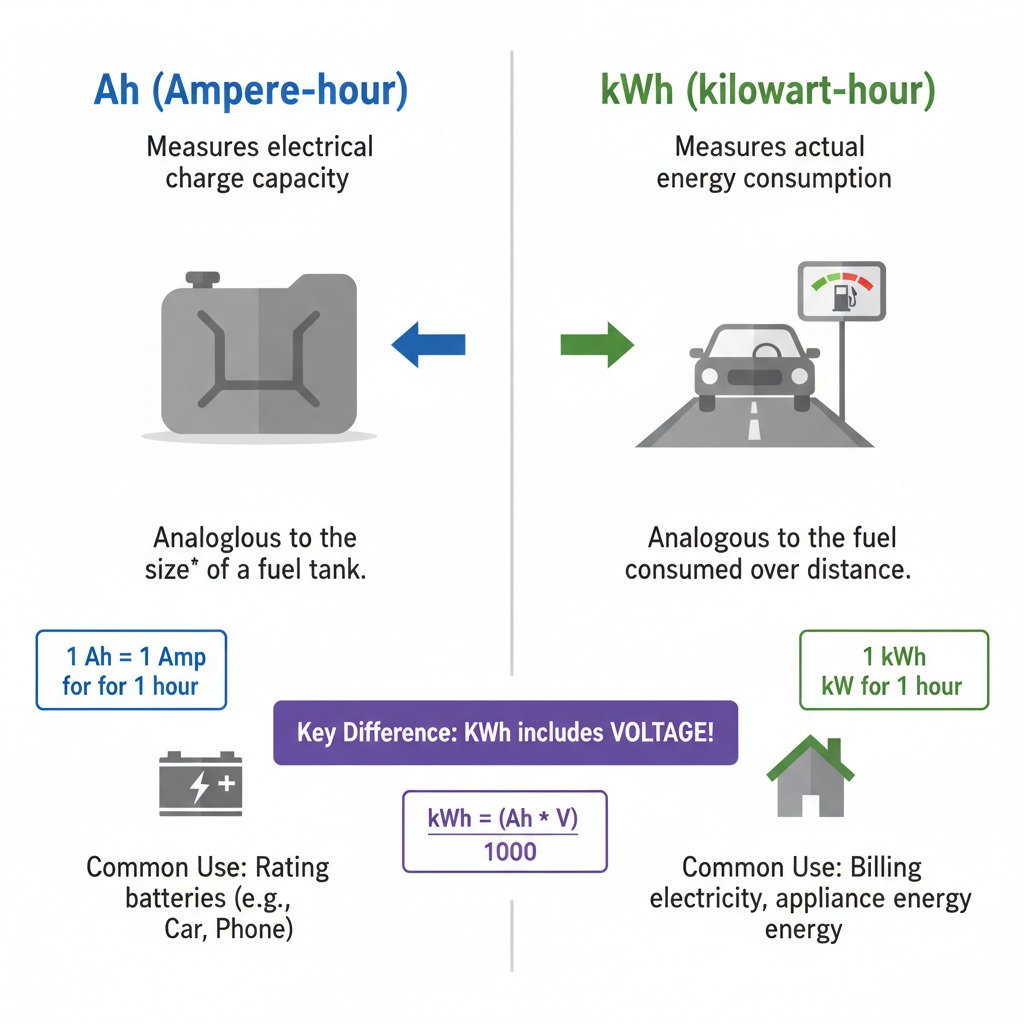
The Ah means ampere-hours. It is a measure of battery capacity, but Ah by itself does not tell you the total amount of energy stored in a battery.
The battery voltage must also be considered.
For example:
12V 200Ah
and
48V 200Ah
do not contain the same amount of energy.
This guide explains what 100Ah, 200Ah and 300Ah mean, how to convert Ah to kWh, and how to know which battery size may be suitable for your solar or inverter system.
Quick Answer: What Does Ah Mean?
Ah means ampere-hours.
It is a way of describing a battery’s electrical capacity.
However, when comparing batteries for solar systems, you should not look at Ah alone.
You should also look at:
- Battery voltage
- Battery chemistry
- Usable capacity
- Maximum discharge power/current
- Recommended depth of discharge
- Manufacturer specifications
A simple way to estimate the battery’s nominal energy is:
Voltage × Ah = Wh
Then:
Wh ÷ 1,000 = kWh
For example:
12V × 200Ah = 2,400Wh
or:
2.4kWh
So a 12V 200Ah battery has approximately 2.4kWh of nominal stored energy.
What Is a 100Ah Battery?
A 100Ah battery has a rated capacity of 100 ampere-hours.
But you must know its voltage before calculating its energy.
12V 100Ah Battery
The simple calculation is:
12V × 100Ah = 1,200Wh
or:
1.2kWh
So a 12V 100Ah battery has approximately 1.2kWh of nominal energy.
24V 100Ah Battery
24V × 100Ah = 2,400Wh
or:
2.4kWh
48V 100Ah Battery
48V × 100Ah = 4,800Wh
or:
4.8kWh
This is why saying:
“I have a 100Ah battery”
is not enough information.
You should also know the battery voltage.
What Is a 200Ah Battery?
A 200Ah battery has twice the Ah rating of a 100Ah battery at the same voltage.
For example:
12V 200Ah
12V × 200Ah = 2,400Wh
or:
2.4kWh
24V 200Ah
24V × 200Ah = 4,800Wh
or:
4.8kWh
48V 200Ah
48V × 200Ah = 9,600Wh
or:
9.6kWh
So a 48V 200Ah battery has four times the nominal energy of a 12V 200Ah battery.
The Ah is the same.
The voltage is different.
What Is a 300Ah Battery?
A 300Ah battery has a larger capacity than a 100Ah or 200Ah battery at the same voltage.
For example:
12V 300Ah
12V × 300Ah = 3,600Wh
or:
3.6kWh
24V 300Ah
24V × 300Ah = 7,200Wh
or:
7.2kWh
48V 300Ah
48V × 300Ah = 14,400Wh
or:
14.4kWh
This does not mean a 300Ah battery will always last longer than every 200Ah battery.
The voltage, battery type, usable capacity and load all matter.
100Ah vs 200Ah vs 300Ah Battery
Here is a simple comparison using a 12V battery:
| Battery | Nominal Energy |
|---|---|
| 12V 100Ah | 1.2kWh |
| 12V 150Ah | 1.8kWh |
| 12V 200Ah | 2.4kWh |
| 12V 220Ah | 2.64kWh |
| 12V 250Ah | 3.0kWh |
| 12V 300Ah | 3.6kWh |
The important point is that these calculations are based on nominal energy.
You cannot assume that all of this energy will be available to your appliances.
Battery chemistry and the manufacturer’s recommended usable capacity matter.
Does 200Ah Mean the Battery Will Supply 200 Amps for One Hour?
Not necessarily.
This is one of the most common misunderstandings about Ah.
A 200Ah rating should not be interpreted as a promise that the battery will always deliver exactly:
200A for 1 hour
Real battery performance depends on the battery design, discharge rate, temperature, age and other conditions.
The Ah rating is better understood as a measure of the battery’s rated capacity under specified test conditions.
For solar applications, you should therefore look at the complete battery specification rather than treating Ah as a simple runtime guarantee.
What Is the Difference Between Ah and kWh?
This is very important when comparing solar batteries.
Ah tells you electrical capacity in relation to current.
kWh tells you stored energy.
For a simple comparison:
Energy = Voltage × Ah
For example:
12V × 200Ah = 2.4kWh
while:
48V × 100Ah = 4.8kWh
Notice something interesting.
The 12V battery has:
200Ah
The 48V battery has:
100Ah
Yet the 48V battery has twice the nominal energy.
This is why you should not compare batteries by Ah alone.
Why Voltage Changes the Meaning of Ah
Suppose you have three batteries:
12V 200Ah
24V 200Ah
48V 200Ah
They all say:
200Ah
But their nominal energy is different.
| Battery | Calculation | Nominal Energy |
|---|---|---|
| 12V 200Ah | 12 × 200 | 2.4kWh |
| 24V 200Ah | 24 × 200 | 4.8kWh |
| 48V 200Ah | 48 × 200 | 9.6kWh |
So if someone tells you:
“This battery is 200Ah.”
Ask:
“What voltage?”
That one question can completely change the comparison.
For a deeper explanation of battery voltage, see our guide to 24V vs 48V solar systems.
How Many 12V 100Ah Batteries Make 24V?
If your inverter requires 24V and you are using 12V batteries, two compatible 12V batteries can normally be connected in series:
12V + 12V = 24V
If both batteries are 100Ah:
2 × 12V 100Ah = 24V 100Ah
The nominal energy is:
24V × 100Ah = 2.4kWh
Notice that the Ah does not double when batteries are connected in series.
The voltage doubles.
How Many 12V 100Ah Batteries Make 48V?
For a 48V battery bank:
12V + 12V + 12V + 12V = 48V
So four 12V 100Ah batteries connected in series give:
48V 100Ah
The nominal energy is:
48V × 100Ah = 4.8kWh
This is also why a 48V 100Ah lithium battery can have approximately the same nominal energy as four 12V 100Ah batteries connected in series.
The actual battery construction, usable capacity and specifications can still be different.
What Happens When Batteries Are Connected in Parallel?
Series and parallel connections do different things.
Series
Series connection increases voltage.
For example:
2 × 12V 200Ah = 24V 200Ah
Parallel
Parallel connection increases Ah capacity while keeping the voltage approximately the same.
For example:
2 × 12V 200Ah = 12V 400Ah
The nominal energy is:
12V × 400Ah = 4.8kWh
So:
Series = increases voltage
Parallel = increases capacity
A real installation must follow the battery and inverter manufacturer’s connection limits.
How Long Will a 100Ah Battery Last?
There is no single answer.
You need to know:
- Battery voltage
- Battery chemistry
- Usable capacity
- Appliance load
- Inverter efficiency
- Battery condition
For a simple theoretical example, suppose you have a:
12V 100Ah battery
Its nominal energy is:
1.2kWh
If the load were:
200W
a very simple calculation would be:
1,200Wh ÷ 200W = 6 hours
But this is not a guaranteed six-hour runtime.
Actual runtime will be affected by usable battery capacity, inverter losses, discharge limits and other factors.
This is why our SolarPriceNG Battery Calculator is more useful for planning a real backup system.
How Long Will a 200Ah Battery Last?
Again, the answer depends on the voltage and load.
Suppose you have:
12V 200Ah
Nominal energy:
2.4kWh
At a simple theoretical load of:
400W
you could calculate:
2,400Wh ÷ 400W = 6 hours
But the real runtime will not necessarily be exactly six hours.
Now consider a 48V 200Ah battery:
48V × 200Ah = 9.6kWh
At the same 400W load:
9,600Wh ÷ 400W = 24 hours
This example shows why Ah alone cannot tell you battery runtime.
The voltage must be included.
How Long Will a 300Ah Battery Last?
Suppose you have a:
12V 300Ah battery
Nominal energy:
12V × 300Ah = 3.6kWh
At a theoretical load of 600W:
3,600Wh ÷ 600W = 6 hours
Again, this is only a simple energy calculation.
Actual backup time depends on usable capacity and system losses.
A 300Ah battery at a different voltage will have a different amount of stored energy.
Can I Use a 200Ah Battery With a 5kVA Inverter?
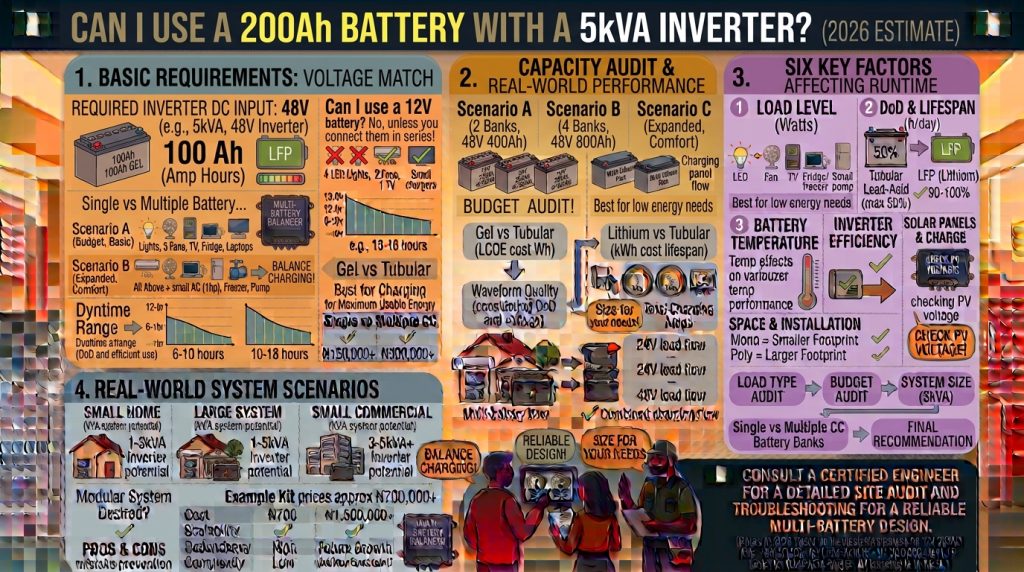
Possibly, but the Ah rating alone does not answer the question.
You must first check the inverter’s battery voltage.
For example, if the inverter requires 48V and you are using 12V 200Ah batteries, four compatible batteries connected in series create:
48V 200Ah
with approximately:
9.6kWh nominal storage
However, you also need to check whether the battery bank can supply the current required by the inverter and your intended load.
This is why we covered the complete battery configuration in our guide on how many batteries you need for a 5kVA inverter in Nigeria.
Is a 300Ah Battery Better Than a 200Ah Battery?
Not automatically.
A 300Ah battery at the same voltage generally has more nominal capacity than a 200Ah battery.
For example:
12V 200Ah = 2.4kWh
12V 300Ah = 3.6kWh
So the 300Ah battery stores more nominal energy.
But “better” depends on what you need.
A 300Ah battery may be unnecessary if your load is small.
Likewise, a 200Ah battery may not provide enough backup for a large load.
You should choose the battery based on your actual energy requirement.
Is a 200Ah Lithium Battery the Same as a 200Ah Tubular Battery?
Not necessarily.
Two batteries can both be labelled:
200Ah
but have different:
- Chemistry
- Usable capacity
- Discharge limits
- Cycle life
- Charging requirements
- Efficiency
- Recommended depth of discharge
For example, lithium batteries can normally provide a greater portion of their rated capacity for use than many traditional lead-acid batteries.
This is one reason you should not compare lithium and tubular batteries using Ah alone.
Our Lithium vs Tubular Battery guide explains the main differences.
What Does 5kWh Mean Compared With 200Ah?
kWh and Ah are different ways of describing battery capacity.
For example:
12V 200Ah
has:
2.4kWh nominal energy
A battery marketed as:
5kWh
has approximately 5kWh of nominal energy, although you still need to check its voltage and exact manufacturer specifications.
A 51.2V 100Ah lithium battery, for example, has:
51.2 × 100 = 5,120Wh
or:
5.12kWh
This is why many modern lithium batteries are sold using kWh rather than Ah.
Which Battery Is Bigger: 12V 200Ah or 48V 100Ah?
The:
48V 100Ah
battery has more nominal energy.
Let’s calculate:
12V 200Ah
12 × 200 = 2,400Wh
2.4kWh
48V 100Ah
48 × 100 = 4,800Wh
4.8kWh
So the 48V 100Ah battery has twice the nominal energy of the 12V 200Ah battery.
This is an important lesson:
Never compare battery Ah without considering voltage.
How Do I Choose Between 100Ah, 200Ah and 300Ah?
Start with your appliances.
For example, if you only need to run:
- LED lights
- TV
- Wi-Fi router
- Fans
- Laptop
your battery requirement may be much lower than someone who wants to run:
- Refrigerator
- Freezer
- Pump
- Air conditioner
- Electric appliances
Next, decide how long you want the appliances to run.
For example:
500W for 4 hours
requires:
500 × 4 = 2,000Wh
or:
2kWh
While:
1,000W for 8 hours
requires:
1,000 × 8 = 8,000Wh
or:
8kWh
This is why the correct battery size should come from your load and backup requirement rather than simply choosing the largest Ah number.
Use the SolarPriceNG Battery Calculator
Instead of guessing whether you need 100Ah, 200Ah, 300Ah or a larger battery, use the SolarPriceNG Battery Calculator.
You can enter:
- Your appliances
- Appliance quantities
- Backup hours
- Battery type
- Battery voltage
- Battery capacity
The calculator can estimate the battery storage and configuration needed for your selected load.
The result should still be checked against the exact battery and inverter manufacturer’s specifications.
Check the Inverter Before Buying the Battery
Your battery must be compatible with your inverter.
Check:
- Required battery voltage
- Maximum charging current
- Maximum discharge current
- Battery capacity range
- Lithium battery compatibility
- Communication requirements
- Maximum number of batteries
- Series and parallel limits
If you are unsure about the inverter size itself, use the SolarPriceNG Inverter Calculator first.
The inverter determines how much power your system can supply at one time.
The battery determines how much energy you can store for backup.
Check Current Battery Prices in Nigeria
Battery capacity also affects the cost of your solar system.
A 100Ah battery will not normally cost the same as a 200Ah or 300Ah battery.
However, price also depends on:
- Battery type
- Brand
- Voltage
- Chemistry
- Warranty
- Usable capacity
- Market availability
You can check the current SolarPriceNG Solar Batteries Prices in Nigeria database to compare available battery models and estimated prices.
For a broader explanation of battery pricing, see our guide on inverter battery prices in Nigeria.
100Ah vs 200Ah vs 300Ah: Simple Comparison
| Battery Size | 12V Nominal Energy | General Meaning |
|---|---|---|
| 100Ah | 1.2kWh | Smaller storage |
| 150Ah | 1.8kWh | More storage |
| 200Ah | 2.4kWh | Larger storage |
| 220Ah | 2.64kWh | Larger storage |
| 250Ah | 3.0kWh | Higher storage |
| 300Ah | 3.6kWh | Higher storage |
This table assumes a 12V battery.
At 24V or 48V, the energy will be different.
Common Mistakes When Buying an Ah Battery
Looking at Ah only
A 200Ah battery can have very different energy storage depending on its voltage.
Assuming more Ah always means better
A larger battery can be unnecessary if your load is small.
Assuming Ah tells you backup time
Runtime depends on the load, voltage, usable capacity and system efficiency.
Ignoring battery chemistry
A 200Ah lithium battery should not automatically be treated as identical to a 200Ah tubular battery.
Ignoring the inverter voltage
The battery voltage must match the inverter’s requirements.
Ignoring discharge capability
The battery must be capable of supplying the required power.
Using nominal capacity as usable capacity
The number printed on the battery does not necessarily represent the amount of energy your appliances will actually receive.
Final Answer: What Do 100Ah, 200Ah and 300Ah Mean?
100Ah, 200Ah and 300Ah describe the battery’s rated capacity in ampere-hours.
But Ah alone is not enough to compare solar batteries.
You also need to know the voltage.
The simple calculation is:
Voltage × Ah = nominal Wh
For example:
12V 100Ah = 1.2kWh
12V 200Ah = 2.4kWh
12V 300Ah = 3.6kWh
At 48V:
48V 100Ah = 4.8kWh
48V 200Ah = 9.6kWh
So a 48V 100Ah battery can contain more nominal energy than a 12V 200Ah battery, even though its Ah rating is lower.
The best battery for your solar system is therefore not simply the one with the highest Ah number.
Choose based on:
Voltage + capacity + usable energy + discharge capability + battery type + inverter compatibility.
If you are unsure how much battery storage you need, use the SolarPriceNG Battery Calculator with your actual appliances and desired backup time.
Frequently Asked Questions
Is 200Ah better than 100Ah?
At the same voltage and under comparable conditions, a 200Ah battery has approximately twice the nominal capacity of a 100Ah battery.
But whether you need 200Ah depends on your load and backup requirement.
How many kWh is a 12V 200Ah battery?
A 12V 200Ah battery has approximately:
12 × 200 = 2,400Wh
or:
2.4kWh nominal energy.
How many kWh is a 48V 100Ah battery?
A 48V 100Ah battery has approximately:
48 × 100 = 4,800Wh
or:
4.8kWh nominal energy.
Is 300Ah enough for a solar system?
It depends on the battery voltage, appliance load and desired backup time.
A 12V 300Ah battery has approximately 3.6kWh nominal energy, while a 48V 300Ah battery has approximately 14.4kWh.
Can I use 200Ah batteries for a 5kVA inverter?
Possibly.
The exact battery voltage, number of batteries, discharge capability and inverter specifications must all be checked.
Is Ah the same as kWh?
No.
Ah measures ampere-hours, while kWh measures energy.
Voltage is needed to convert Ah into Wh:
Wh = V × Ah
Does a higher Ah battery last longer?
Usually, a higher-capacity battery at the same voltage can provide more energy and therefore longer backup under the same load.
But actual runtime also depends on usable capacity, battery type, inverter efficiency, battery condition and other factors.
Related SolarPriceNG Guides
If you are learning about solar batteries, these guides can help you go further:
- How Many Batteries Do I Need for a Solar System in Nigeria?
- How Many Batteries Do I Need for a 5kVA Inverter in Nigeria?
- 24V vs 48V Solar System: Which Should You Choose?
- How Long Will a 5kWh Lithium Battery Last in Nigeria?
- Lithium vs Tubular Battery: Which Is Better for Solar in Nigeria?
- Inverter Battery Price in Nigeria: Lithium vs Tubular vs GEL